Pigmentation Removal Laser: What to Do When Dark Spots Keep Coming Back

There is a quiet frustration that comes with pigmentation.
For Claire, it was not one dramatic change. It was the way her skin looked uneven in every photo. The brown patches on her cheeks seemed darker after summer. The freckles across her nose looked more noticeable under office lighting. A few post-acne marks stayed long after the breakouts had healed. Even when her skin felt smooth, her complexion still looked patchy.
She had tried brightening serums. She had bought vitamin C products. She had changed foundation shades, used more concealer and avoided taking photos in direct light. Some days her skin looked better. Then after a sunny weekend, the darker areas seemed to return.
Like many people searching for pigmentation removal laser, Claire was not chasing perfect skin. She simply wanted to stop feeling like she had to cover her face before leaving the house. She wanted to understand why the marks kept returning, why skincare alone was not enough, and whether there was a more targeted way to support clearer, more even-looking skin.
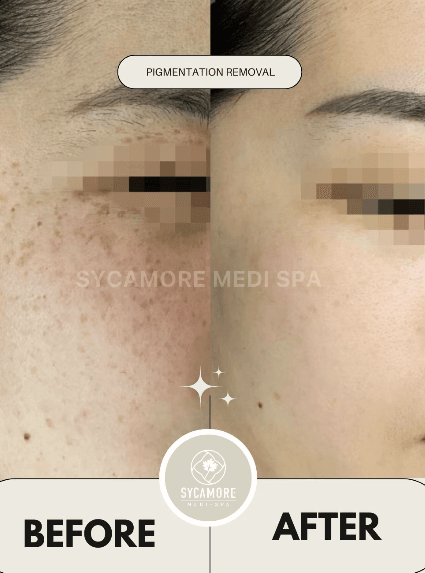
That is where a professional pigmentation plan can make a difference. At Sycamore, Laser Pigmentation Removal is designed to target concerns such as dark spots, sun damage, melasma, freckles, age spots and uneven pigmentation using Q-Switched Nd:YAG pigment laser technology.
The Real Pain Point: “My Skin Looks Dull Even When It Is Healthy”
Pigmentation can feel unfair because the skin may be healthy in every other way. It may not be breaking out. It may not feel dry. It may not have deep lines. Yet the uneven tone can make the whole face look tired, older or less fresh.
For many clients, the emotional impact is not about vanity. It is about confidence. Pigmentation can make people feel like their skin looks constantly sun-damaged, even when they are careful. It can make makeup feel necessary rather than optional. It can draw attention away from otherwise healthy skin.
This is one reason pigmentation treatment is so commonly researched. People are not always looking for dramatic rejuvenation. They often want a calmer, clearer, more balanced complexion that feels easier to manage day to day.
But to treat pigmentation properly, it helps to understand why it appears in the first place.
Why Pigmentation Keeps Coming Back
Pigmentation happens when melanin, the pigment that gives skin its colour, becomes unevenly distributed or overproduced in certain areas. This can create visible dark spots, patches, freckles, age spots or post-inflammatory marks.
Sycamore’s Laser Pigmentation Removal page explains that pigmentation may be linked to sun exposure, genetics, skin type, skin injury, hormonal changes, pregnancy, acne, certain illnesses and some medications.
This is why pigmentation can be so persistent. A spot may fade slightly, then deepen again after sun exposure. A post-acne mark may improve slowly, then remain visible for months. Melasma may be influenced by heat, hormones and UV exposure, making it more complex than a simple sun spot.
Australia’s UV conditions also matter. Cancer Council NSW explains that UVA can penetrate deeply into the skin and contribute to photo-ageing, including wrinkles and pigmentation, while UVB is strongly linked to sunburn. Cancer Council Australia also notes that Australia has one of the highest rates of skin cancer in the world, making sun protection an essential part of any skin plan.
For Claire, this helped explain why the patches on her cheeks never fully stayed away. They were not just surface marks. They were part of a larger pattern involving UV exposure, skin history and how her skin produced pigment.
Why Brightening Skincare Is Not Always Enough
Brightening skincare can be helpful, especially when used consistently with daily sun protection. Ingredients such as vitamin C, niacinamide, exfoliating acids and pigment-supportive products may improve the look of uneven tone over time.
But skincare has limits.
A serum works gradually on the surface and upper layers of the skin. It may soften the appearance of some marks, but it may not be enough for deeper pigmentation, established sun spots or stubborn patches that return after exposure to UV or heat.
This is where many people become frustrated. They feel like they are doing everything right, but their pigmentation still controls how their skin looks. They may keep buying stronger products, exfoliating more often or layering more actives, only to end up with irritation, sensitivity or more unevenness.
Pigmentation-prone skin does not always need more intensity. Sometimes it needs a more targeted professional approach and a safer long-term maintenance plan.
What Is Pigmentation Removal Laser?
Pigmentation removal laser is a professional treatment that uses laser energy to target excess pigment in the skin. The goal is to break down selected pigment so the body can gradually clear it as part of the natural healing process.
At Sycamore, the treatment uses Q-Switched Nd:YAG pigment laser technology. This type of laser is commonly used in cosmetic and dermatology settings for pigment-related concerns, with suitability depending on the type of pigmentation, skin tone, treatment area and individual response.
DερmNet explains that Nd:YAG laser treatment involves placing a handpiece against the skin and activating the laser, with patients commonly describing the sensation as similar to a rubber band snapping against the skin. DermNet also notes that eye protection should be worn during treatment and that sun protection is important during a course of laser treatment to reduce the risk of post-inflammatory pigmentation.
For clients searching for pigmentation removal laser, this is an important distinction. Laser treatment is not the same as a brightening facial. It is an energy-based treatment that should be planned carefully and performed with appropriate assessment, safety steps and aftercare.
Why Laser Safety Matters
Because pigmentation removal laser uses light energy, the choice of provider matters. It should not be treated like a casual add-on or chosen only because a before-and-after photo looks impressive.
ARPANSA, Australia’s radiation protection authority, advises consumers to understand the risks before undergoing laser, IPL or LED cosmetic treatments. ARPANSA explains that light-based treatments target specific chemicals in the skin called chromophores, including pigments that give the skin its colour. It also warns that incorrectly performed treatments may lead to persistent pigment changes, scarring or eye injury.
ARPANSA also advises that skin blemishes or moles should be examined by a doctor before cosmetic light-based treatment if the treatment is not performed or supervised by a registered medical practitioner.
This is especially important for pigmentation because not every dark mark should be treated cosmetically. A changing mole, irregular lesion or suspicious spot needs medical assessment first. A professional clinic should understand when to treat and when to refer.
Why Assessment Comes Before Treatment
One of the biggest mistakes people make with pigmentation is assuming every brown spot is the same.
A freckle is not always the same as an age spot. Melasma behaves differently from sun damage. Post-acne pigmentation is different again. Some pigmentation is superficial, while other pigmentation sits deeper. Some skin types are more reactive and have a higher risk of rebound pigmentation or post-inflammatory hyperpigmentation.
This is why Sycamore’s consultation process matters. A good pigmentation plan should consider what type of pigmentation is present, how long it has been there, what may be triggering it, whether the skin is inflamed or sensitive, and whether the client has had recent sun exposure.
It should also consider the client’s home routine. Strong actives, recent peels, retinoids, exfoliating acids and sun exposure can all affect treatment timing.
For Claire, this was reassuring. She did not want someone to simply “laser the spots”. She wanted to know why those spots were appearing and how to reduce the chance of making them worse.
What Concerns Can Laser Pigmentation Removal Help With?
Sycamore’s treatment page describes Laser Pigmentation Removal as suitable for concerns such as dark spots, sun damage, melasma, freckles, age spots and other pigmentation concerns. Treatment areas may include the full face, half face, décolletage, hands, upper back, arms, shoulders or a single spot, depending on the client’s needs and suitability.
This is helpful because pigmentation often appears in more than one place. Some clients are most concerned about the cheeks. Others notice sun spots on the hands. Some see uneven tone on the chest or shoulders after years of sun exposure. Others feel frustrated by post-acne marks across the face.
A personalised plan allows the treatment area and approach to match the concern, instead of treating the skin as if every mark has the same cause.
Why Pigmentation May Look Darker Before It Looks Better
One of the most important things to understand about pigmentation removal laser is that the skin may go through visible changes after treatment.
Sycamore notes that possible reactions can include warmth, tingling, temporary colour changes, temporary darkening of pigmentation, mild pinpoint bleeding, possible acne flare in acne-prone skin and temporary pigment rebound during the treatment process.
This can be worrying if the client has not been prepared for it. A treated spot may look darker before it starts to fade. The skin may feel sensitive. The area may need careful protection and time to recover.
DερmNet notes that Nd:YAG laser side effects may include temporary redness, swelling, itching, discomfort, blistering in rare cases, and changes in skin pigmentation, including darker or lighter patches.
This is why aftercare is not optional. It is part of the treatment.
What Aftercare Really Means
Aftercare is not just a list of rules. It is what helps protect the skin while it repairs.
Sycamore advises clients to avoid touching, scratching or picking the treated area. Any scabs should fall off naturally. Active skincare should be paused during recovery, and professional repair-focused products may be recommended. Clients should also avoid UV exposure and strong light during recovery, using physical protection such as hats, masks or umbrellas when outdoors.
This matters because newly treated skin can be more vulnerable. Picking, scrubbing, using strong actives too soon or returning to sun exposure can increase the risk of irritation and pigment rebound.
For Claire, the aftercare plan changed the way she thought about treatment. Laser was not a quick shortcut. It was a targeted step in a longer skin correction journey.
Why Sun Protection Is the Long-Term Key
Even the best pigmentation treatment can be undermined by UV exposure.
Cancer Council NSW recommends using a combination of sun protection measures when UV levels are 3 and above, including clothing, sunscreen, hats, shade and sunglasses. It also recommends broad-spectrum SPF50 sunscreen, applied before going outside and reapplied regularly.
For pigmentation-prone skin, this is especially important. Sunscreen is not only about preventing sunburn. It is also part of managing uneven tone, photo-ageing and the risk of pigmentation returning.
This is why a professional pigmentation plan should always include daily sun protection. Laser may help target existing pigment, but long-term maintenance depends on reducing the triggers that keep stimulating it.
Why Sycamore’s Approach Is Different
The value of Sycamore’s approach is not only the laser itself. It is the combination of assessment, technology, aftercare and personalised planning.
Pigmentation can be emotionally frustrating because it often feels like a cycle. Cover it. Treat it. Watch it return. Try something stronger. Irritate the skin. Start again.
A professional plan helps break that cycle by asking better questions. What kind of pigmentation is this? Is the skin ready for laser? Has there been recent sun exposure? Is melasma involved? Is the client using actives that should be paused? Does the mark need medical review first? What should aftercare look like?
At Sycamore Medi Spa, pigmentation treatment sits within a broader skin health menu, which means clients can be guided toward the treatment that best suits their concern rather than being pushed into a one-size-fits-all option.
For Claire, the difference was feeling understood. Her pigmentation was not treated like a simple cosmetic flaw. It was treated as part of her skin history.
Is Pigmentation Removal Laser Right for You?
You may consider a consultation if dark spots, freckles, sun damage, age spots, melasma or post-acne marks are making your skin look uneven, or if skincare has not delivered the clarity you were hoping for.
A consultation is also important if you are unsure what type of pigmentation you have. Any spot that is changing, irregular, bleeding, rapidly growing or unusual should be checked by a medical professional before cosmetic treatment.
Pigmentation removal laser may be suitable for some clients, but it is not suitable for everyone. Skin tone, pigmentation type, recent sun exposure, sensitivity, medical history and expectations all matter.
The right plan should feel careful, informed and realistic.
Ready to Stop Covering Dark Spots and Start Understanding Them?
Searching for pigmentation removal laser often begins with frustration. You may be tired of concealer. Tired of uneven tone returning after sun exposure. Tired of products that promise clarity but only make a small difference.
At Sycamore, pigmentation treatment begins with understanding your skin. Whether your concern is dark spots, sun damage, melasma, freckles, age spots or post-acne pigmentation, the first step is a professional consultation that helps identify what your skin actually needs.
Explore Sycamore’s pigmentation treatment here: Laser Pigmentation Removal
Explore Sycamore’s full treatment menu here: Sycamore Medi Spa Treatments
Call Sycamore today to book your consultation and begin your journey to clearer, more even-looking skin.
✨ Pigmentation removal laser. Targeted skin correction. Clearer-looking skin starts with the right plan. ✨