Why Is My Jawline Losing Definition?

You haven't gained much weight. Your clothes fit the same, the number on the scale hasn't really moved, and when you look at older photographs, your face doesn't necessarily look “bigger”. But there is one change you keep noticing: your jawline doesn't look quite as sharp as it used to.
Maybe the transition between your jaw and neck looks softer in photographs. Perhaps there is a little more looseness beneath the chin, or your lower face seems less defined when you turn slightly to the side. It can be tempting to immediately blame weight gain and start searching for ways to “slim” the face.
But facial definition isn't controlled by body weight alone.
Changes in skin elasticity, collagen, underlying facial structures and the way different tissues age can all influence how the lower face looks. That is why someone researching Face Tightening Canberra may actually be dealing with a very different concern from someone simply trying to reduce overall body weight.
Sycamore Medi Spa separates these goals within its own treatment menu. Ultherapy PRIME sits within its Anti-Aging Firming and Lifting category, alongside other non-invasive lifting technologies, rather than being presented as a weight-loss treatment.
So if the scale hasn't changed, what exactly happened to your jawline?
Your Jawline Is More Than a Line
When we say somebody has a “defined jawline”, it sounds like we're describing one anatomical feature. Visually, however, that line is created by the relationship between several parts of the lower face and neck. Skin quality and elasticity matter, but so do underlying tissues, facial anatomy and age-related structural changes. This is why two people of the same age and similar body weight can have completely different lower-face contours.
The ageing face is also more complex than the simple idea that “skin gets loose”. Research into facial ageing describes changes occurring across multiple layers, including skin, fat compartments and underlying skeletal structures. These changes interact rather than happening independently. In practical terms, this means the outline you see in a photograph can gradually change even if your overall body size remains relatively stable.
This distinction matters because Face Tightening Canberra treatments are designed around a particular problem. If skin laxity and loss of elasticity are contributing to softer contours, a firming or lifting treatment may be relevant. If the concern is primarily related to excess facial or submental fat, however, simply choosing a skin-tightening technology because you dislike your jawline may not address the dominant issue.
The first question therefore isn't “How do I get a sharper jaw?”
It is “Why has my jawline become less defined?”
The Scale Doesn't Measure Skin Laxity
Body weight is easy to measure, so naturally it becomes the first explanation we reach for when the face changes. But your bathroom scale cannot tell you how firm your skin is, how much collagen has changed or whether the tissues around your lower face are sitting exactly as they did several years ago.
Collagen is an important structural component of skin, and changes in collagen organisation and production form part of the biological ageing process. That doesn't mean everyone suddenly develops loose skin at a particular birthday. Ageing is gradual, and genetics, cumulative environmental exposure and individual anatomy all contribute to how those changes become visible.
This can produce a frustrating situation. You may exercise regularly and maintain approximately the same weight, yet the angle between the lower face and neck doesn't photograph the way it once did. Trying to lose more weight simply because you want a sharper jawline can therefore be a poor assumption—particularly if weight wasn't the main reason the contour changed.
This is where the language of Face Lifting and Tightening becomes more useful. Sycamore specifically positions Ultherapy PRIME Canberra as a non-invasive treatment for people experiencing some degree of skin laxity or loss of elasticity. The clinic also makes an important distinction: Ultherapy PRIME does not duplicate the results of a surgical facelift.
That gives the treatment a much clearer role. It isn't there to make every face smaller. It is there to participate in a conversation about lifting and tightening when laxity is actually part of the concern.
Look at Your Old Photos Differently
Old photographs can be surprisingly useful, but not if you're simply asking, “Did I look younger?”
Instead, compare specific areas.
Look at the transition from your chin towards the jaw. Look at the angle underneath the chin. Look at the lower cheeks and the outline where the face meets the neck. Then compare photographs taken at roughly similar angles rather than putting a carefully posed selfie beside an accidental photo taken from below.
What you're looking for is where the change seems to be happening.
If the entire face appears fuller after a significant change in body weight, that gives you one piece of information. If your weight is stable but the lower-face outline has gradually become softer, skin and structural ageing may deserve more attention. If your jawline looks fine but your skin itself appears rough, pigmented or dull, you may not have a Face Tightening problem at all.
This is one reason Sycamore's treatment range separates Anti-Aging Firming and Lifting from Skin Rejuvenation and Targeted Skin Treatment. A person bothered by pigmentation doesn't automatically need lifting. Someone bothered by acne scars doesn't automatically need tightening. And someone whose main concern is a softer lower-face contour shouldn't assume that a brightening facial will produce a structural lift.
“Make me look younger” is vague.
“My lower-face contour has become softer” is something you can actually investigate.
Is It Loose Skin—or Something Under the Skin?
This distinction deserves more attention because “soft jawline” can describe several different appearances.
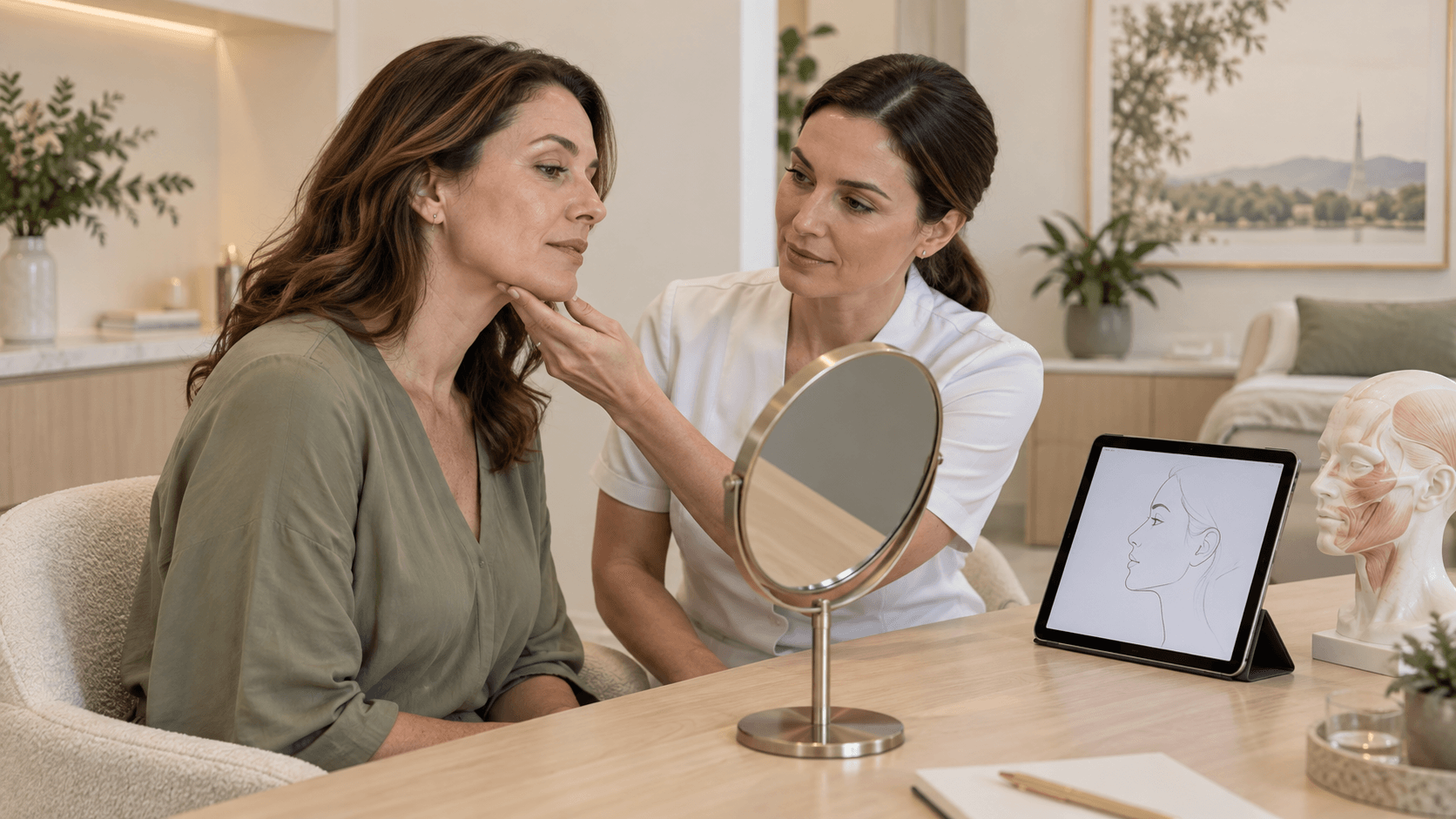
Imagine gently turning your head in front of a mirror. One person may notice mild looseness of the skin beneath the chin. Another may have relatively firm skin but naturally carry more fullness in the area. A third may notice changes around the lower cheeks that affect the transition into the jawline. To the person looking in the mirror, all three can feel like the same complaint: “I lost my jawline.”
They aren't necessarily the same treatment problem.
This is why a good Face Tightening Canberra consultation shouldn't begin by promising that one device will “sculpt” every type of lower face. It should begin by identifying whether laxity is actually contributing to what you see.
Sycamore describes Ultherapy PRIME as using focused ultrasound beneath the skin's surface to stimulate collagen production and create a gradual lifting effect. Its FDA-cleared indications include lifting skin on the neck, under the chin and brow, as well as improving lines and wrinkles on the décolleté.
That makes the under-chin and neck areas particularly relevant to this article—but only when the concern matches what the technology is designed to address.
Why Your Jawline Can Look Different From One Day to the Next
There is another reason people become worried about their jawline: sometimes it seems sharp in one photograph and almost absent in another.
That doesn't mean your facial structure changed overnight.
Camera distance, focal length, head position, lighting and posture can dramatically change the appearance of the lower face. Looking down towards a phone compresses the area beneath the chin. A photograph taken from below can emphasise fullness. Strong overhead lighting can create shadows that make contours look sharper, while flat frontal lighting can make them appear softer.
Even the way you hold your neck matters.
This is why judging whether you need Face Lifting Canberra from one bad photograph is rarely useful. Before deciding something has dramatically changed, look for a consistent pattern across normal photographs and the mirror over time.
The goal isn't to become hyper-aware of every millimetre of your face. It is the opposite: to stop one unflattering camera angle from convincing you that you suddenly need an aesthetic procedure.
If the softer contour is persistent and laxity appears to be part of it, then researching treatments such as Ultherapy PRIME Canberra makes more sense. Sycamore's dedicated Ultherapy PRIME treatment page is a better starting point than trying to diagnose your jawline through selfies.
Can Skincare Actually Lift Your Jawline?
This is where expectations around skincare can become unrealistic.
A good skincare routine remains important. Cleansing, moisturising and appropriate sun protection can support the condition and appearance of the skin. Active skincare ingredients may also be useful for particular surface-level concerns.
But applying a cream to the surface and targeting deeper tissue with an energy-based treatment are not the same thing.
If your main concern is dryness, dullness or surface texture, skincare may make a meaningful difference to how healthy and refined the complexion appears. If what bothers you is a genuine change in lower-face laxity, however, buying progressively more expensive “lifting creams” doesn't necessarily mean you're addressing the same target as a professional Face Tightening procedure.
This distinction is especially useful because people often confuse better skin quality with better facial definition.
You can have beautifully hydrated skin and still feel that your jawline has softened. You can also have a naturally sharp jawline while dealing with pigmentation, acne scarring or rough texture.
Sycamore reflects that difference by placing treatments such as Meso Microneedling, IPL and WishPro within Skin Rejuvenation while Ultherapy PRIME, Ultraformer III and LIFTERA COOL appear within Anti-Aging Firming and Lifting.
A glow and a lift are both cosmetic goals.
They just aren't interchangeable ones.
Sun Exposure Belongs in the Ageing Conversation Too
When people think about a changing jawline, gravity usually gets all the blame. But facial ageing isn't purely a mechanical process.
Cumulative ultraviolet exposure contributes to photoageing and changes in skin structure over time. In Australia, that makes everyday sun protection relevant not only when you're worried about pigmentation but also as part of a broader long-term skin strategy.
Cancer Council Australia recommends using sun protection when the UV Index is 3 or above, including protective clothing, shade, sunglasses and sunscreen as appropriate.
This doesn't mean sunscreen will lift an already softened jawline. It means prevention and correction have different jobs.
A professional Face Tightening Canberra treatment may be considered when laxity is already visible and bothersome. Daily sun protection, meanwhile, remains part of reducing unnecessary ongoing UV exposure. Treating one as a replacement for the other misses the point.
The same principle applies after professional treatment. Sycamore's Ultherapy PRIME aftercarerecommends daily SPF 50+ and avoiding excessive sun exposure around treatment.
When Does a Softer Jawline Become a Face Tightening Concern?
There isn't a universal moment when somebody “needs” Face Tightening.
Some people notice very subtle laxity and aren't bothered by it at all. Others become conscious of the lower face because it changes how they look in photographs. Neither reaction tells you how old someone is or whether treatment is necessary.
A more useful question is whether laxity is actually the feature you want to change.
Try imagining three possible improvements. In the first, your skin becomes brighter and more hydrated tomorrow, but your jawline remains exactly the same. In the second, pigmentation becomes more even but the lower-face outline doesn't change. In the third, the complexion stays essentially the same but the lower face looks somewhat firmer and more defined.
Which one sounds closest to what you actually want?
If the third option is clearly the most appealing, then you are beginning to describe a Face Lifting and Tightening goal rather than a general Skin Rejuvenation goal.
That is the point at which Sycamore's Anti-Aging Firming and Lifting treatments, including Ultherapy PRIME, become more relevant to your research.
Why the Lower Face Often Gets Your Attention Before the Rest of Your Face
Facial ageing doesn't always announce itself with one dramatic change. In fact, many people don't initially notice a new wrinkle or suddenly think their skin looks significantly older. Instead, the first clue can be something much less specific: the lower face doesn't photograph the way it used to. You might still be happy with your forehead, cheeks and overall skin quality, but the transition from the cheeks into the jaw begins to look softer. The area beneath the chin may seem less crisp from certain angles, or the lower face may appear slightly heavier even though your actual weight has remained relatively stable. This can happen because facial ageing is a multi-layered process. Changes in skin elasticity occur alongside changes in deeper facial tissues, meaning the visual outline of the face can evolve gradually rather than simply developing wrinkles on the surface. That is also why Face Tightening Canberra shouldn't automatically be grouped together with treatments designed primarily for brightness, pigmentation or surface texture. Someone can have smooth, well-hydrated and relatively even-toned skin while still feeling that facial definition has changed.
This distinction becomes especially useful when you compare the lower face with the upper face. Imagine that your main complaint isn't crow's feet, forehead lines or dullness. When you pull your hair back or look at a three-quarter photograph, what catches your attention is the softer transition around the jaw and neck. Booking another brightening facial might make your complexion look fresher, but it wouldn't necessarily address the feature that made you start researching treatments in the first place. Sycamore separates Anti-Aging Firming and Lifting from its broader Skin Rejuvenation treatments, which provides a useful framework for thinking about this difference. Treatments such as WishPro or other rejuvenation options may be considered around skin appearance and quality, while technologies such as Ultherapy PRIME Canberra are positioned around firming and lifting. Neither category is automatically more advanced than the other; they are trying to change different things.
This is also why the lower face can become a useful starting point when defining an anti-ageing goal. Rather than saying “I want to look five years younger”, which doesn't tell a practitioner very much, you can identify the specific feature that has changed: perhaps it is mild laxity beneath the chin, reduced definition along the jaw or a generally softer lower-face contour. Once the concern becomes specific, it becomes much easier to decide whether Face Lifting and Tightening is actually the right treatment category. It also prevents you from spending time chasing unrelated concerns simply because they are commonly marketed under the same broad “anti-ageing” label. The goal isn't to analyse every part of your face for imperfections. It is to understand whether the thing you already noticed is fundamentally about skin quality or facial support and definition.
Why “Tightening” and “Lifting” Aren't Exactly the Same Goal
The words tightening and lifting are often placed next to each other in aesthetic treatment descriptions, which can make them sound completely interchangeable. From a client's perspective, however, they can describe slightly different expectations. When someone says they want tighter skin, they may be thinking about skin that feels or appears less lax, particularly around the lower face and neck. When they say they want a lift, they may be imagining a visible improvement in how the facial contour sits. Those goals overlap, but neither should be interpreted as “change the entire shape of my face”. This is particularly important when researching non-surgical Face Lifting Canberra, because the word “lifting” can easily create expectations closer to surgery than to a non-invasive energy-based procedure.
A useful way to clarify your own expectation is to stop using the treatment terminology for a moment. Instead of saying, “I want lifting and tightening”, describe the actual change you hope to notice. Maybe you want the skin beneath the chin to appear somewhat firmer. Perhaps you want the jawline to look a little better defined from the side. Or maybe you aren't concerned about the jaw at all—you simply want fine lines and roughness to improve. That last goal would take you back towards Skin Rejuvenation Canberra, showing why terminology matters. Sycamore places Ultherapy PRIME within Anti-Aging Firming and Lifting and describes it as a non-invasive ultrasound treatment designed to gradually lift and tighten areas including the neck and beneath the chin. Importantly, Sycamore also states that Ultherapy does not duplicate the results of a surgical facelift. That single distinction helps keep the word “lifting” grounded in what a non-surgical treatment is actually intended to offer.
This can also prevent another common mistake: deciding that a treatment has failed because it didn't create a completely different facial shape. Face Tightening isn't facial redesign. Your underlying anatomy still matters, and a naturally softer jaw shape isn't automatically a sign of laxity. If someone has always had a relatively rounded lower face, tightening treatment shouldn't be approached as a way of turning their natural anatomy into somebody else's angular jawline. The more realistic goal is to look at what has changed from that person's own baseline. If the jawline was previously more defined and has gradually softened as laxity developed, then a treatment aimed at firming and lifting becomes easier to understand. The comparison should therefore be you now versus your own earlier facial contour, not you versus a filtered photograph of somebody with completely different bone structure.
Your Treatment Goal Should Still Make Sense Without the Word “Anti-Ageing”
“Anti-ageing” is one of the biggest umbrella terms in the beauty industry, and that can make treatment decisions unnecessarily confusing. Pigmentation removal can be called anti-ageing because sun spots can make a complexion look older. Microneedling can be described as anti-ageing because people may use it for fine lines and skin texture. A hydrating facial can be marketed as anti-ageing because plumper-looking skin can appear fresher. Face Tightening can also sit under the anti-ageing umbrella because facial laxity can become more noticeable over time. If everything is anti-ageing, however, the phrase doesn't actually tell you what a treatment is supposed to change.
A better approach is to remove the phrase entirely and see whether your goal still makes sense. Instead of saying, “I want an anti-ageing treatment,” try saying, “I want the brown pigmentation on my cheeks to look less noticeable.” That points towards a pigmentation conversation. Say, “I want the old acne scars on my cheeks to look smoother,” and Microneedling Canberra becomes more relevant. Say, “My skin looks tired and I want a refreshed appearance,” and you are moving towards facial and Skin Rejuvenation options. But if your sentence is, “The skin around my lower face and under my chin has gradually become less firm and I would like to improve its definition,” you have finally described a genuine Face Tightening Canberra search intent. Sycamore's full treatment range is structured across these different concerns, which makes this concern-first approach much more useful than simply choosing something because it carries an anti-ageing label.
This way of thinking is particularly valuable before considering Ultherapy PRIME Canberra. Rather than booking it because you've reached a certain age or because ultrasound lifting is trending, you can judge whether the treatment category matches the change you actually want. Sycamore's Ultherapy PRIME treatment information focuses on non-invasive lifting and tightening and explains that results develop gradually as collagen production is stimulated. That treatment logic makes much more sense when your concern is laxity than when your real problem is pigmentation, acne scarring or simple dehydration. It also makes expectations easier to manage: you aren't asking Ultherapy PRIME to brighten dark spots, resurface acne scars and produce an instant surgical transformation at the same time. You are giving the treatment one clear job. And in a crowded Skin Rejuvenation Canberra market, that may be one of the simplest ways to make a better treatment decision—define the change first, then choose the technology, rather than choosing a technology and hoping it somehow improves everything.
Why Ultherapy PRIME Works Below the Surface
If the concern is genuine skin laxity, treating only the visible surface doesn't fully explain what a lifting technology is trying to do.
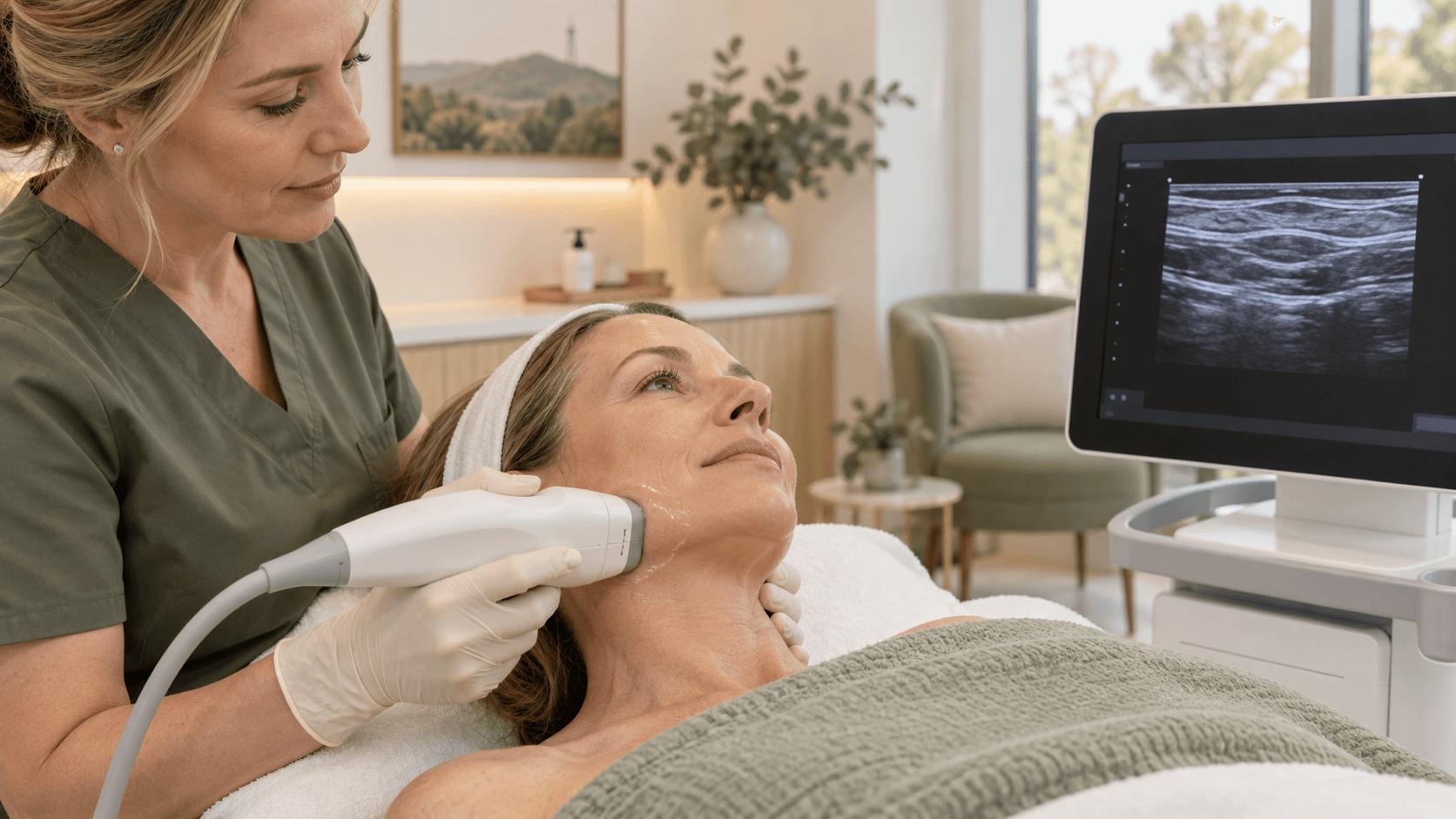
Ultherapy PRIME uses micro-focused ultrasound energy and real-time ultrasound imaging. Sycamore explains that the imaging allows the practitioner to visualise tissue layers and personalise energy delivery, while the ultrasound energy is used to stimulate the body's collagen-building process beneath the skin.
This real-time visualisation is one of the features that distinguishes Ultherapy PRIME within the broader non-invasive lifting category.
For someone researching Face Tightening Canberra, the important part isn't simply that the machine uses ultrasound. It is understanding why a treatment aimed at laxity is working beneath the surface rather than trying to polish the top layer of the skin.
Sycamore currently highlights the neck and under-chin area among Ultherapy PRIME's FDA-cleared lifting indications, alongside the brow and lines and wrinkles on the décolleté.
That makes it relevant when the concern is a gradual loss of definition around the lower face and neck. It doesn't make it an automatic solution for every person who wants a sharper-looking jaw.
The Real-Time Imaging Part Matters More Than It Sounds
“Real-time ultrasound imaging” can easily sound like another technical phrase added to a treatment page, but it has a practical purpose.
Faces aren't identical.
The thickness and position of tissue can vary between individuals and across different parts of the same face. Ultherapy PRIME allows the practitioner to visualise the tissue being treated rather than delivering energy without that imaging information. Sycamore describes this visualisation as a way to assess the skin and personalise where energy is delivered.
This fits neatly with the main idea of this article: a jawline isn't just a generic line that needs tightening.
If your concern comes from a particular pattern of laxity, your anatomy matters. That is why choosing a clinic treatment based only on somebody else's before-and-after photograph doesn't tell you how your own face should be approached.
Sycamore has also discussed the personalised aspect of the technology in its existing Ultherapy PRIME Canberra article, including the role of real-time imaging and customised treatment planning.
The machine matters, but the assessment matters too.
Face Tightening Is Not the Same as a Surgical Facelift
The phrase non-surgical facelift is common in aesthetic marketing, but it can create the wrong mental picture.
Ultherapy PRIME is non-invasive. A surgical facelift is surgery.
Those aren't minor variations of the same procedure.
Sycamore explicitly states that Ultherapy treatment will not duplicate the results of a surgical facelift, while positioning it as a non-invasive alternative for people who aren't ready for surgery.
That expectation is important when evaluating a softer jawline. Mild or moderate laxity and a desire for gradual, non-surgical improvement are very different from expecting dramatic repositioning of significantly lax tissues.
It also means you shouldn't judge Ultherapy PRIME Canberra by asking whether it can recreate a surgical transformation without surgery. That's not a fair comparison.
A better question is whether the degree of change you want matches what a non-invasive lifting treatment is designed to offer.
Don't Expect Your Jawline to Change the Next Morning
One reason people misunderstand collagen-focused treatments is that we're used to instant visual feedback.
Get a haircut and you know immediately what changed. Apply makeup and the result appears in minutes. Even a hydrating facial can sometimes make the complexion look refreshed quickly.
Ultherapy PRIME works on a different timeline.
Sycamore explains that results develop gradually as collagen production increases, with full effects appearing over approximately three to six months. The clinic also states that the treatment requires no special downtime, although temporary redness or swelling can occur.
That gradual timeline matters psychologically.
If you spend every morning examining your jawline from three centimetres away, small changes can be difficult to recognise. Consistent photographs taken at similar angles and under similar lighting can be more useful than relying on memory.
And importantly, “gradual” shouldn't be translated into “guaranteed”. Individual results vary, and suitability should be assessed before treatment.
What About Downtime?
For many people researching Face Tightening Canberra, the treatment decision isn't only about results. It is also about how easily the procedure fits around work, family and social commitments.
Sycamore describes Ultherapy PRIME as requiring no special downtime, with makeup able to be applied immediately afterwards. Mild redness or swelling may occur and can last from several hours to a few days.
The clinic's aftercare guidance also recommends avoiding excessive heat, including saunas and intense exercise, for at least 48 hours and avoiding strong skincare actives for approximately one week. It advises leaving at least two weeks before aesthetic treatments such as laser or microneedling.
That last point is particularly useful if you're building a broader Skin Rejuvenation Canberra plan.
Perhaps your jawline is your main concern, but you also want microneedling for texture or pigmentation treatment for dark spots. Having several concerns doesn't mean every procedure should be squeezed into the same week. Different treatments have different purposes and appropriate timing.
Don't Choose Face Tightening Based on Age Alone
“I've turned 40, so I probably need lifting.”
That isn't a particularly useful way to choose treatment.
Two people can be exactly the same age and have very different facial structures, skin quality, degrees of laxity and aesthetic preferences. One may notice lower-face softness relatively early. Another may retain a naturally defined jawline much later.
Chronological age tells you surprisingly little about what actually bothers you.
Instead of deciding that a certain birthday automatically means Ultherapy PRIME Canberra, look at the concern itself. Has the skin around the neck or under the chin become noticeably less firm? Has your facial outline gradually softened? Is that change significant enough that you actually want to address it?
If not, there is no requirement to chase a treatment simply because it is labelled “anti-ageing”.
Sycamore's treatment menu includes many different pathways—from Skin Rejuvenation to Targeted Skin Treatment and Anti-Aging Firming and Lifting . The right category depends on the concern, not the number on your birthday cake.
A Sharper Jawline Isn't Always the Goal
There is also a bigger point worth making: a highly sculpted jawline isn't an objective requirement for an attractive or youthful face.
Social media has made extremely defined lower faces unusually visible. Filters, strategic lighting, makeup, posing and cosmetic procedures can all influence the images we repeatedly see. After enough exposure, perfectly normal facial softness can begin to look like something that “needs” correction.
It doesn't.
Aesthetic treatment is optional. The useful role of Face Tightening Canberra isn't to convince everybody that their jaw should look sharper. It is to provide an option for people who have noticed laxity, understand what they want to change and prefer a non-invasive approach.
This perspective also helps create more realistic treatment goals. Instead of asking to reproduce somebody else's jawline, the conversation becomes about your own anatomy and whether modest improvement in firmness or definition would satisfy you.
That is much easier to assess—and much harder for an Instagram filter to decide on your behalf.
Your Weight Hasn't Changed—But Your Face Can
So if you've been staring at old photographs wondering why your jawline looks different even though the scale barely moved, don't assume you've done something wrong.
Facial ageing doesn't follow your bathroom scale.
Skin elasticity and collagen change over time, while deeper facial structures and tissues also contribute to how contours appear. Weight can certainly influence facial appearance, but it is only one part of a much larger picture.
If your main concern is a gradual softening around the lower face, chin or neck, exploring Face Tightening Canberra may make more sense than endlessly trying to “slim” an area that isn't primarily a weight problem.
Sycamore offers Ultherapy PRIME Canberra within its Anti-Aging Firming and Lifting range. The treatment uses micro-focused ultrasound with real-time imaging, and its FDA-cleared lifting indications include the neck and under the chin. Sycamore also clearly notes that it is a non-invasive treatment and does not reproduce the results of a surgical facelift.
You can also explore Sycamore's broader Anti-Aging Firming and Lifting treatments or read its existing Ultherapy PRIME Canberra guide to understand where the technology fits within a wider treatment plan.
Because sometimes the question isn't:
“Why did my face get bigger?”
It is:
“Has the way my lower face is supported and defined gradually changed?”