Pigmentation Laser vs Microneedling: Marks or Scars?

The breakout disappeared months ago. The redness settled, you stopped reaching for concealer every morning, and technically the acne is “gone”. But when you look at your skin in bright daylight, it doesn't really feel gone at all.
Some areas are still darker than the surrounding skin. Other areas look uneven when light hits your cheeks from the side. You may call all of them acne scars, because they are all reminders of the same breakouts. But from a treatment perspective, they may be completely different problems.
This distinction matters when you're comparing Pigmentation Removal Laser Canberra with Microneedling Canberra. Sycamore Medi Spa currently places Laser Pigmentation Removal within its Targeted Skin Treatment category and Meso Microneedling within Skin Rejuvenation. They aren't simply two competing ways to do the same job. One conversation may be primarily about unwanted colour, while the other may be about changes in the physical texture of the skin.
So before asking which treatment is “better”, there is a much more useful question:
Did your acne leave a mark—or did it leave a scar?
The Easiest Test: Is It Colour or Is It Texture?
Imagine running your fingers gently across an area where you previously had acne. The skin feels relatively smooth, but when you look in the mirror there is still a brown or darker patch where the blemish used to be. That may be a pigmentation issue rather than a true indented acne scar. Post-inflammatory hyperpigmentation, commonly shortened to PIH, can occur after inflammation or injury and leaves increased pigmentation in the affected area.
Now imagine the colour isn't particularly noticeable, but under side lighting you can see small depressions in the skin. Your fingertips may also detect that the surface isn't as smooth as the surrounding area. That begins to sound more like a textural acne-scar concern.
And, of course, you can have both.
This is why people searching for acne scar treatment in Canberra can easily end up looking at treatments designed for different targets. The original acne may have caused inflammation that left visible colour behind, while some lesions may also have changed the skin's structure. From a distance, everything gets grouped together as “old acne marks”. Up close, one cheek may actually contain several different concerns.
That difference is the foundation for comparing Pigmentation Removal Laser and Microneedling. If colour is what catches your attention first, pigmentation becomes an important part of the conversation. If indentations, roughness or uneven texture bother you more, microneedling becomes more relevant. Sycamore's existing Microneedling Canberra guide discusses acne scars, uneven texture and enlarged-looking pores among the concerns people commonly investigate microneedling for.

Why Acne Can Leave a Dark Mark Without Leaving a Dent
One reason this topic becomes confusing is that a visible reminder of acne doesn't automatically mean the skin has developed a structural scar.
After inflammation settles, increased pigment can remain in the area. This is why a spot can become completely flat yet still be easy to see months later. The problem isn't necessarily that the skin surface needs rebuilding; it may be that the colour of that area remains different from the surrounding complexion.
This distinction becomes particularly important before jumping straight into a scar-focused treatment plan. A systematic review of treatments for post-inflammatory hyperpigmentation found that many of the PIH cases studied were associated with acne, while also showing that treatment response varies and complete clearance isn't guaranteed. Laser and energy-based treatments were among the approaches studied, but the review also reported worsening PIH in a small proportion of laser/energy-treated patients.
That is a good reminder that Pigmentation Removal Laser Canberra shouldn't be interpreted as “there is a brown spot, so laser it”. Pigmentation has different causes and presentations, and suitability matters. Sycamore's own complete guide to pigmentation removal laser similarly stresses that pigmentation is medically complex and that individual suitability depends on factors including skin type, medical history and the particular type of pigmentation.
A Scar Changes the Conversation
Now look at the same old breakout from another angle.
The brown colour may have faded almost completely, but a shallow depression remains. Under direct bathroom lighting it might barely bother you. Then sunlight comes through a window from the side and suddenly the texture becomes much more obvious.
This is where Microneedling Canberra enters a different treatment conversation.
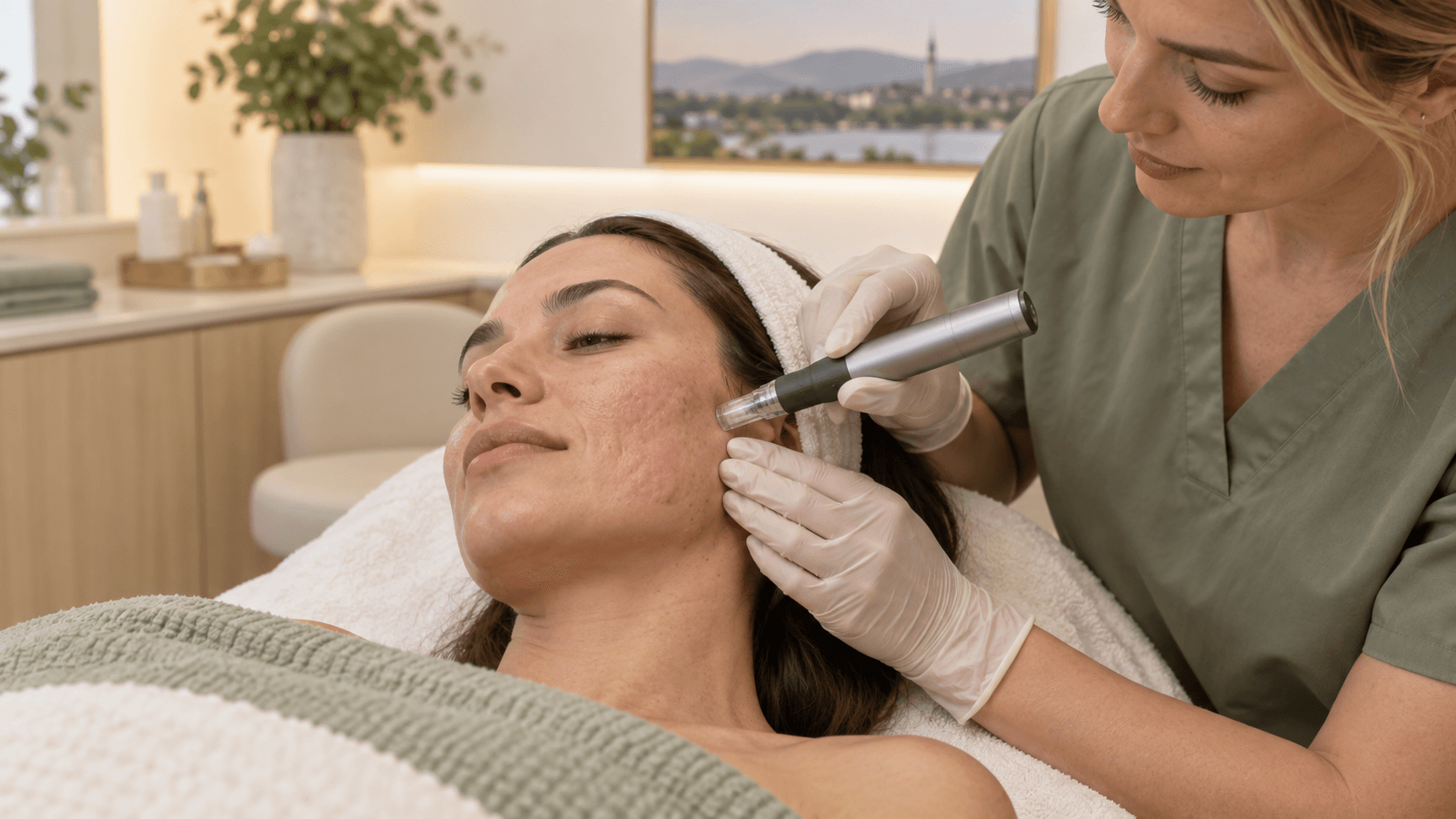
Microneedling creates controlled micro-injuries that trigger a wound-healing response and collagen remodelling. That mechanism is one reason it has been studied for atrophic acne scars. A systematic review and meta-analysis of randomised controlled trials found microneedling to be a favourable treatment option for acne scarring.
Sycamore also lists Meso Microneedling within its Skin Rejuvenation treatments, while its dedicated article Can Microneedling Help with Acne Scars, Pores, and Fine Lines? approaches microneedling specifically through texture-related concerns.
The important point is not that microneedling is automatically appropriate for every scar. Acne scars themselves vary in morphology and severity. The useful distinction for someone beginning their research is simpler: a flat dark mark and an indentation aren't automatically the same treatment target just because the same pimple created them.
The Side-Light Test Can Tell You More Than the Bathroom Mirror
If you're struggling to describe what bothers you, changing the lighting can be surprisingly revealing.
Stand near a window and allow natural light to fall across the face from the side rather than directly in front. Don't do this to obsess over every pore—everyone's skin has texture. Instead, look at what happens to the areas you normally call “acne marks”.
If the problem remains visible mainly because the area is darker than the surrounding skin, colour may be dominating your concern. If the problem becomes dramatically more noticeable because tiny shadows form around depressions or irregularities, texture may be contributing more than you realised. If both happen, you have probably discovered why one simple label never seemed to describe your skin properly.
You can try the same thing with photographs. Compare a front-facing image taken in even light with an image taken near a window. Pigmentation may remain visually obvious across different lighting conditions because the colour itself is different. Textural irregularities can appear much stronger or weaker depending on the direction of light.
This isn't a diagnosis, and it doesn't replace professional skin assessment. But it can help you communicate your goal much more clearly. Instead of arriving at a consultation saying, “I want to remove my acne scars,” you can explain that the brown marks bother you most, the indentations bother you most, or both are important.
That information is far more useful when discussing Sycamore's different Skin Rejuvenation Canberra and targeted skin treatments.
What If You Have Both Marks and Scars?
This is probably the most interesting part of the comparison because real skin rarely arrives with one perfectly isolated problem.
You might have several flat brown post-acne marks across the cheeks, a few shallow depressions from older breakouts and some areas where colour and texture overlap. From a normal conversational perspective, calling all of that “acne scarring” is understandable. From a treatment-planning perspective, however, separating those concerns can make the pathway much clearer.
Instead of asking:
“Should I choose laser or microneedling?”
Try asking:
“Which part of my skin is bothering me most right now?”
If the dark marks create most of the visible unevenness, a pigmentation-focused assessment may become the first priority. If the colour has already faded significantly and the indentations are what you notice in photographs, a Microneedling Canberra discussion may make more sense. If both contribute equally, the treatment plan may need to consider both concerns rather than pretending that one procedure must solve everything.
Sycamore has previously discussed this broader idea in its Canberra Skin Treatments guide: different technologies can address different parts of an overlapping skin concern, making treatment sequence important rather than treating every technology as a direct competitor.
So Which Should You Treat First?
This is where there isn't one universal order.
Imagine two people with exactly the same number of old acne lesions. The first person's main concern is the collection of dark marks that makes the overall complexion look uneven from across the room. The second person's pigmentation has mostly settled, but textural scars become obvious whenever light hits the cheeks.
Even though both people say “I want to fix my acne scars”, their priorities aren't identical.
For the first person, investigating pigmentation first may make the biggest visual difference to what currently bothers them. For the second, improving texture may be the more relevant goal. A third person may have ongoing acne or inflammation, which can change the conversation again because continuing breakouts can create new marks while older ones are being treated.
This is why copying someone's treatment order from Reddit, TikTok or a before-and-after video isn't particularly useful. Their skin type, scar pattern, pigmentation, active acne and treatment history may be completely different from yours.
Even laser treatment for PIH requires caution. A systematic review specifically examining lasers for post-inflammatory hyperpigmentation found that some studies reported improvement while others reported no improvement or worsening, and the authors noted limitations in the available evidence.
So “laser first” and “microneedling first” shouldn't become universal rules. Treatment order should follow the problem, not the popularity of the procedure.
Don't Treat New Acne Like an Old Acne Scar
There is another important complication: what if you're still breaking out?
If new inflammatory acne continues to appear, you aren't dealing only with the history of acne. You are dealing with an active process that may continue creating new marks or scars. In that situation, immediately building an entire cosmetic plan around removing yesterday's pigmentation while today's breakouts are still appearing can miss part of the problem.
This is why it's useful to separate active acne, post-acne pigmentation and established acne scars in your mind. They may appear on the same face at the same time, but they aren't interchangeable terms.
Sycamore's treatment menu reflects this separation. It lists Acne Treatment within Targeted Skin Treatment, Laser Pigmentation Removal for pigmentation concerns and Meso Microneedling within Skin Rejuvenation.
That doesn't mean someone necessarily needs three treatments. It means a consultation should identify what is active, what is leftover colour and what represents structural texture change before deciding what actually belongs in the plan.
The goal isn't to collect treatments. It is to stop asking one treatment to solve three different problems.
Why Clearer Colour Can Make Scars Seem More Noticeable
Here is something that can surprise people during a skin journey: improving one concern may change how you perceive another.
Imagine your cheeks currently have noticeable brown marks and shallow textural scars. The pigmentation attracts your eye first, so the texture doesn't seem like the main problem. As the overall tone becomes more even, you may suddenly notice the indentations more.
That doesn't automatically mean the scars became worse.
It may simply mean that the visual “noise” created by uneven colour has reduced, revealing a second concern that was already there.
The reverse can happen too. When smoother-looking texture changes the way light falls across the skin, you may become more conscious of individual dark spots that previously blended into a generally uneven complexion.
This is why good Skin Rejuvenation Canberra planning can be iterative. You don't always need to decide the entire treatment journey on day one. Sometimes it makes sense to identify the dominant concern, address it appropriately, allow the skin to settle and then reassess what still matters to you.
Sycamore's Canberra Skin Solutions guide similarly discusses pigmentation and texture as overlapping concerns that may require different treatment strategies rather than one universal procedure.
Your Acne History Can Matter More Than How Your Skin Looks Today
When people start researching Pigmentation Removal Laser Canberra or Microneedling Canberra, they usually focus on what they can see in the mirror today. But the history behind those marks can be just as useful as their current appearance. Think about when the acne was active, how inflammatory the breakouts were, whether you picked or squeezed them, how long the remaining colour has been visible and whether the affected areas have changed naturally over time. Two marks that look similar today may have arrived there through very different journeys. A relatively recent flat post-acne mark may still be evolving after the original inflammation has settled, while an indentation that has remained visible for years represents a very different type of concern. This is one reason it can be misleading to look at a single photograph online, find something that resembles your cheek and immediately decide that you need the same procedure.
Your acne history can also help explain why different areas of the same face may need to be assessed separately. Perhaps the occasional small breakout around your forehead usually disappears without leaving much behind, while deeper inflammatory acne on your cheeks repeatedly leaves dark marks or noticeable texture. Or maybe the pigmentation from newer breakouts bothers you now, but several older depressions have remained relatively unchanged for years. Instead of treating the entire face as one uniform “acne scar problem”, a more useful Skin Rejuvenation Canberra conversation can separate newer post-inflammatory colour from established textural changes. Sycamore's Microneedling Canberra guide for acne scars, pores and fine lines focuses on texture-related concerns, while its Pigmentation Removal Laser Canberra guide approaches pigmentation as its own treatment category. The important point is that your face doesn't need to fit neatly into one label before a treatment plan can make sense.
This is also why bringing a short history of your skin to a consultation can sometimes be more useful than arriving with a treatment already selected. You don't need a complicated diary. Simply knowing roughly when the marks appeared, whether they followed acne, whether they are still changing and which areas have remained stable can provide useful context. If you are still experiencing significant or persistent acne, that is also worth raising rather than focusing only on removing the evidence left by previous breakouts. A cosmetic treatment plan should not assume that every visible mark has the same origin, and unusual or changing pigmented lesions should not simply be treated as ordinary post-acne pigmentation without appropriate assessment. The aim of comparing Pigmentation Laser vs Microneedling is therefore not to identify a universal winner; it is to understand why the story behind the skin can influence what you decide to address next.
One Treatment Session Shouldn't Become the Test of Whether Your Skin “Responds”
Another trap is judging these treatments through the expectation of one dramatic before-and-after moment. Someone books a procedure, checks the mirror repeatedly over the next few days and starts deciding whether the treatment “worked”. But both pigmentation concerns and established acne scars can involve processes that are more complicated than an instant cosmetic change. In published research on microneedling for acne scarring, improvement is commonly assessed across treatment courses and follow-up periods rather than assuming that the appearance immediately after one session represents the final outcome. A systematic review of randomised controlled trials examining microneedling for atrophic acne scars found overall improvement across included studies while also highlighting variation in protocols and outcome measurements. This doesn't mean everybody needs the same number of sessions; it means that expectations should match the type of concern being treated rather than an arbitrary “one treatment should fix it” rule.
Pigmentation also needs realistic expectations, but for a different reason. Dark marks can vary in depth, cause and response, and improvement isn't necessarily perfectly even across every spot. Someone may have a cluster of post-acne marks that developed at different times, meaning one area can appear to change faster than another. New UV exposure or new inflammation can further complicate what you see in the mirror. This is why [Sycamore's Pigmentation Removal Laser Canberra content] (https://www.sycamoremedispa.com.au/blog/why-dark-spots-keep-coming-back-and-how-pigmentation-removal-laser-in-canberra-may-help) discusses pigmentation as an ongoing skin concern rather than presenting laser as an instant eraser. It also reinforces why daily sun protection remains relevant. Cancer Council Australia recommends sun protection when UV levels reach 3 or above , so a professional pigmentation treatment should sit alongside sensible everyday protection rather than being expected to compensate for repeated UV exposure.
A better way to evaluate a treatment journey is to establish what you are measuring before you begin. For pigmentation, perhaps your goal is a more even-looking overall complexion or reduced visibility of particular post-acne marks. For microneedling, perhaps the priority is the appearance of shallow acne scars or uneven surface texture. Take consistent photographs if appropriate—similar lighting, angle and distance—rather than comparing today's harsh bathroom lighting with a flattering photograph from six months ago. Most importantly, don't keep changing the goal halfway through. If you chose Microneedling Canberra because texture was your biggest concern, it doesn't make sense to judge the entire treatment only by whether one dark spot disappeared. Likewise, a pigmentation-focused treatment shouldn't be declared unsuccessful because an established indentation is still visible. A treatment can only be judged fairly against the problem it was selected to address.
The Best End Result May Be “More Even Skin”, but There Are Different Ways to Get There
There is a reason pigmentation and acne scarring become so easily mixed together: from the client's perspective, both can contribute to exactly the same emotional description—“my skin looks uneven.” You may not care whether the unevenness has a technical name when you're standing in front of the mirror. You simply want the cheeks to look clearer, smoother and less marked. But “more even skin” actually contains several visual components. There is tone, meaning whether areas of the complexion appear darker, redder or otherwise different in colour. There is texture, meaning how smooth or irregular the physical surface appears. And then there is the interaction between the two. A dark mark over a smooth surface can attract attention because of contrast, while a colour-matched indentation can become obvious because directional light creates a shadow. When both occur together, the overall effect can appear stronger than either concern alone.
This is where the broader idea of Skin Rejuvenation Canberra becomes useful. Rejuvenation doesn't have to mean finding one machine that promises to make everything younger, brighter, tighter and smoother at once. Sycamore's current treatment range separates Skin Rejuvenation from Targeted Skin Treatment and also offers different technologies within those categories. That structure reflects an important idea: similar-looking cosmetic complaints can have different treatment targets. If pigmentation is creating most of the visual unevenness, improving colour may make the complexion look substantially clearer even before texture becomes the main focus. If scars are creating shadows and irregularity, improving surface quality may make the face look more even even though some residual colour remains. And if both are significant, the eventual result may depend on a staged approach in which each concern is reassessed rather than trying to force one procedure to carry the entire treatment plan.
This also changes how you think about the phrase “before and after”. Instead of searching for someone whose face looks exactly like yours and copying their treatment, look at what specifically changed in their photographs. Did the brown marks become less noticeable while the surface texture remained similar? Did shadows from acne scars soften while pigmentation was still present? Did the overall complexion become more uniform because several concerns were addressed over time? Those questions are much more useful than simply deciding that one photograph looks “better”. Sycamore's broader guide to laser, microneedling and other Canberra skin solutions follows the same concern-led logic. When you understand that “even skin” can mean more even colour, smoother texture, or both, choosing between Pigmentation Removal Laser and Microneedling becomes much less confusing.
Microneedling Isn't Simply a “Weaker Laser”
Another misconception comes from thinking of aesthetic treatments as a ladder.
Facial at the bottom. Microneedling somewhere in the middle. Laser above it. Surgery at the top.
Skin treatment doesn't really work like that.
A technology can be more intensive in one sense while being completely irrelevant to the concern you're trying to change. Microneedling isn't simply a weaker version of pigmentation laser, because its mechanism and common treatment goals are different. Likewise, pigmentation-focused laser isn't automatically an “upgrade” from microneedling.
If your main concern is atrophic acne scarring, choosing something because the word “laser” sounds stronger doesn't automatically make it better suited to that particular goal. If your main concern is unwanted pigment, choosing microneedling simply because collagen induction sounds impressive may also miss the point.
This is one reason Sycamore separates Laser Pigmentation Removal and Meso Microneedling across different treatment categories rather than presenting them as basic and premium versions of one service.
When comparing Pigmentation Laser vs Microneedling, the better question is therefore not “Which technology is more powerful?”
It is:
“Powerful at doing what?”
Your Skin Type Matters—Especially When Pigmentation Is Involved
Treatment selection also can't be separated from skin type and individual pigment response.
Post-inflammatory hyperpigmentation can be particularly persistent in people who are more prone to pigment changes after inflammation. And because cosmetic procedures themselves create controlled effects in the skin, treatment settings, suitability and aftercare matter.
This is especially important when people discover a dramatic before-and-after online and assume the same treatment settings should produce the same outcome for everyone. They shouldn't. The systematic review of PIH treatment outcomes mentioned earlier found variable responses across treatment approaches, reinforcing that pigmentation isn't a one-size-fits-all problem.
The same caution applies to microneedling. Although evidence supports its use for acne scarring, the appropriate approach depends on the individual skin concern, scar characteristics and treatment context rather than simply booking the maximum intensity available.
For that reason, someone researching Pigmentation Removal Laser Canberra or Microneedling Canberra should treat online comparisons as educational starting points—not personal prescriptions.
Sun Protection Still Matters After the Acne Is Gone
There is an understandable tendency to think the pigmentation story ends once the original pimple disappears.
But post-acne pigmentation is still pigmentation.
If you are investing time and money into creating a more even-looking complexion, daily sun protection remains an important part of the broader plan. Cancer Council Australia recommends using sun protection when the UV Index is 3 or above and advises combining sunscreen with other protective measures.
This matters particularly in a Canberra-focused treatment journey because cosmetic procedures don't replace everyday UV protection. A Pigmentation Removal Laser Canberra plan should not be treated as permission to stop thinking about sun exposure once visible marks begin to improve.
The same principle applies if you're concentrating primarily on Microneedling Canberra for texture. Professional treatment may address a specific cosmetic goal, while everyday skincare and sun protection continue doing a different job.
Treatment and maintenance aren't competitors.
They are different parts of the same skin strategy.
Don't Let the Word “Scar” Choose Your Treatment
The language we use can quietly push us towards the wrong conclusion.
If you call every post-acne mark a “scar”, you may automatically search for scar treatments. If you call every brown mark “pigmentation”, you may overlook the fact that texture is actually what bothers you most.
So strip the labels away for a moment.
Look at your skin and ask:
Is the area flat but darker?
That points the conversation towards pigmentation.
Is the colour fairly normal but the surface indented or irregular?
That points more towards texture and scar assessment.
Is it both darker and uneven?
You may need to think about two treatment targets.
Are new breakouts still appearing?
Active acne may need to become part of the plan before you focus entirely on what previous acne left behind.
This is a much more useful starting point than asking the internet whether Pigmentation Laser or Microneedling is better.
Pigmentation Laser vs Microneedling: Start With the Problem, Not the Machine
If acne has left both marks and scars, you don't necessarily need to choose a lifelong “team”.
Pigmentation Removal Laser Canberra and Microneedling Canberra occupy different places within a broader skin-treatment strategy. Sycamore currently lists Laser Pigmentation Removal under Targeted Skin Treatment and Meso Microneedling under Skin Rejuvenation, alongside other options designed for different skin concerns.
If unwanted colour is the main issue, start by understanding the pigmentation. Sycamore's Pigmentation Removal Laser Canberra guide provides a deeper introduction to pigmentation assessment and treatment. If uneven texture and established acne scars are more important, its Microneedling Canberra guide explores microneedling from that perspective.
And if you look closely and realise you have both?
That doesn't mean your skin is unusually complicated. It simply means acne left behind more than one kind of reminder.
The useful next step isn't finding the treatment with the strongest marketing claim. It is identifying which reminder you want to address first.