Ultherapy for Skin Tightening in Canberra: Who Is It Best For?
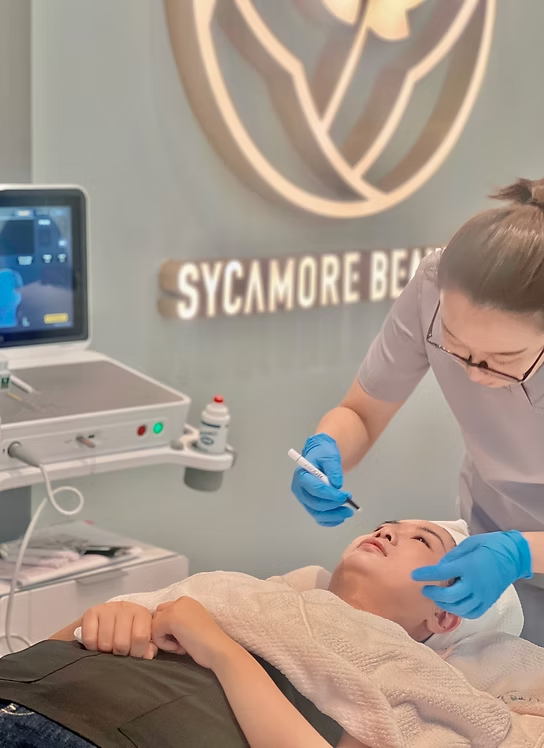
If your skin does not look quite as firm or defined as it once did, you are not imagining it. For many people, the early signs of ageing appear gradually rather than all at once. It might be a softer jawline, a little more heaviness through the lower face, or loose skin around the neck and under the chin that seems more noticeable in certain lighting or photos. At that stage, many are not ready for surgery, but they do want something that feels effective, refined, and realistic for everyday life.
That is where Ultherapy has become such a popular option. Rather than changing the face dramatically, it is designed to support a gradual lifting and tightening effect by stimulating your body’s own collagen response. For people who want to look fresher and more defined without the downtime or commitment of surgery, it offers a middle ground that feels both modern and practical. At Sycamore Medi Spa, Ultherapy PRIME is used as a non-invasive treatment option for areas such as the brow, jawline, neck, and under the chin, making it especially appealing for clients who want natural-looking improvement rather than an obvious transformation.
What sets Ultherapy apart from many other treatments is that it works beneath the surface, targeting deeper structural layers where support naturally starts to weaken over time. Instead of creating a short-term cosmetic effect, the treatment focuses on encouraging collagen production in a way that develops progressively. That is one of the reasons it appeals to people who want subtle, believable results rather than anything overly noticeable.
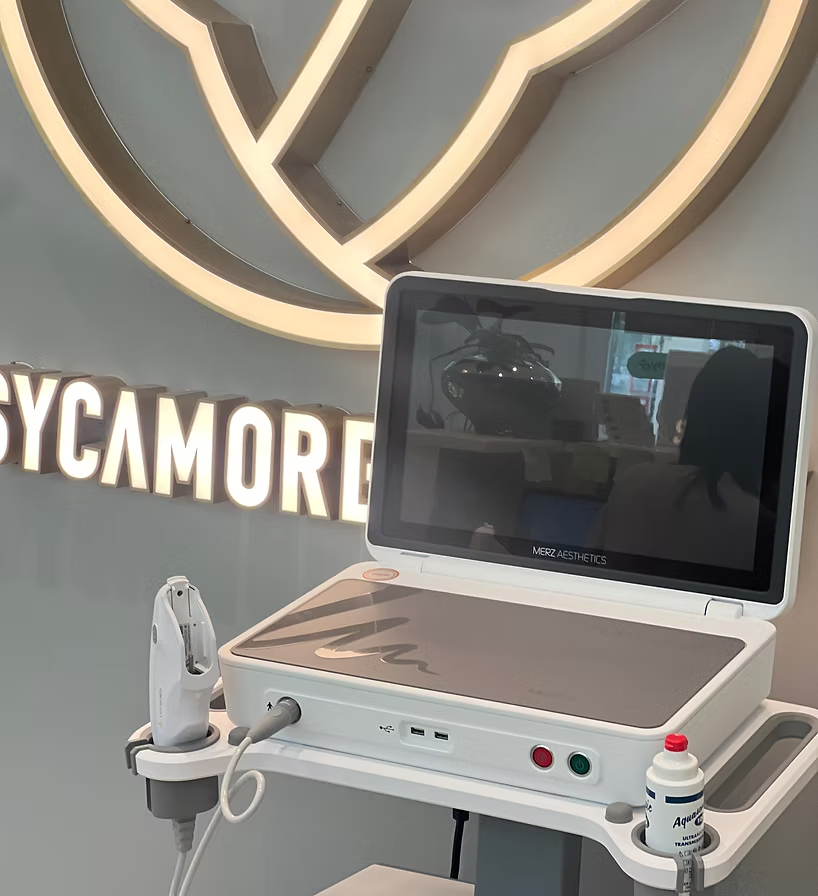
For clients in Canberra considering skin tightening treatments, this approach can be particularly attractive. Ultherapy PRIME combines ultrasound technology with real-time visualisation, allowing treatment to be tailored more precisely to the individual. The result is a treatment experience that feels less like a quick beauty fix and more like a considered, long-term approach to firmer, more supported skin.
What Ultherapy actually does beneath the skin
A lot of people hear the phrase “skin tightening” and assume every treatment works in roughly the same way, but that is not really true. Ultherapy uses focused ultrasound energy to target deeper layers beneath the skin’s surface without cutting or disrupting the outer layer. According to the official Ultherapy site, the treatment is designed to reach the same tissue planes often addressed in a facelift, but in a non-invasive way. Broader guidance from the American Board of Cosmetic Surgery explains that non-surgical skin tightening treatments generally work by heating deeper layers of tissue to stimulate collagen and elastin production, which is why the visible changes tend to build gradually over the following weeks and months rather than appearing instantly. This is one of the key reasons Ultherapy is often associated with a natural-looking result. You are not simply swelling the area or masking the issue temporarily; you are encouraging the skin’s own support structure to rebuild over time.
That deeper mechanism also helps explain why Ultherapy is often discussed in the same conversation as a non-surgical facelift Canberra treatment, but it is important to be realistic with that phrase. Ultherapy can create lift, contour improvement, and firmer-looking skin, especially in the brow, jawline, neck, and under-chin area, but it does not remove excess skin the way surgery can. The language that tends to fit best is that it is a clinically supported non-invasive lifting option for people who are not ready for surgery, do not need surgery yet, or simply prefer a more conservative approach. A systematic review of micro-focused ultrasound treatment published on PubMed Central found that multiple studies reported improvement in facial laxity and aesthetic appearance, including sustained results in some patient groups over time. That body of evidence is part of the reason Ultherapy has remained relevant for clients who want measurable improvement without taking the surgical route.
So, who is Ultherapy best for?
The simplest answer is this: Ultherapy is usually best for people with mild to moderate skin laxity who want a natural improvement in firmness and lift, especially around the face and neck, without surgery. That may sound broad, but in practice it describes a very recognisable group of people. They are often noticing that their lower face looks less defined in photos, that makeup sits differently around the jawline, that the neck appears softer than it used to, or that the brow and upper face do not look as rested as before. They do not necessarily want a dramatic change. They want to look fresher, firmer, and a little more lifted. Guidance from the American Board of Cosmetic Surgery specifically notes that non-surgical skin tightening is best suited to patients bothered by mild to moderate laxity rather than advanced sagging, and that ultrasound treatments can be effective both for younger patients wanting to maintain their skin profile and for older patients wanting a mini-lift effect without surgery.
In a real-world Canberra context, that often includes professionals who do not want visible downtime, parents who want a treatment that fits around work and family life, and clients who value subtlety over shock value. It also includes people who are starting earlier and thinking preventatively. Not everyone who chooses Ultherapy is trying to “fix” severe ageing. Many simply want to respond to the first clear signs of collagen loss before those signs become more pronounced. Sycamore’s Ultherapy PRIME page positions the treatment as ideal for those experiencing some degree of skin laxity or loss of elasticity, which aligns closely with broader clinical guidance. In other words, a good candidate is not necessarily someone with the most dramatic concern. Very often, the best candidate is the person whose concern is noticeable, but not yet extreme.
You may be a strong candidate for Ultherapy if:
- you are seeing early to moderate sagging around the jawline, chin, neck, or brow
- you want a more defined and rested look without surgery
- you prefer gradual, natural-looking improvement over dramatic instant change
- you can be patient while collagen rebuilds over the following months
- you value low downtime and want to return to normal routines quickly
Who may not be the ideal candidate?
This is where honest consultation matters. Ultherapy is not the best answer for every face, every concern, or every expectation. If someone has significant loose skin, heavy jowling, or a large amount of excess tissue that really needs repositioning or removal, a non-invasive approach may not create the degree of lift they are imagining. Likewise, if the main issue is not laxity but volume loss, treatment texture, scarring, pigmentation, or dehydration, Ultherapy alone may not be the most logical first step. A face can look older for many reasons, and not all of them are solved by tightening. This is why the “right treatment” conversation is always more useful than the “best treatment” conversation. The American Board of Cosmetic Surgery notes clearly that non-surgical skin tightening is not effective for more advanced sagging and is better suited to mild to moderate laxity.
It may also be the wrong fit for people who want immediate transformation. Ultherapy is not designed to deliver a same-day dramatic lift. Some clients may notice an early sense of firmness, but the meaningful result typically develops progressively as collagen remodelling takes place. If someone is preparing for an event next week and wants a fast visible change, this may not be the best timing or the best modality. The official Ultherapy positioning and independent guidance both emphasise gradual improvement, with results commonly becoming more apparent over two to three months and lasting up to a year or more depending on the person and the treatment plan. That means the right candidate is also someone whose expectations match the biological pace of the treatment.
It may not be the first choice if:
- you expect the same level of change as surgery
- you have advanced laxity with a lot of excess skin
- your main concerns are pigmentation, acne scarring, or surface texture rather than skin laxity
- you want instant results for a very near-term event
- you are not open to a personalised treatment plan that may include other modalities as well
Is there a “best age” for Ultherapy?
People often ask whether Ultherapy is best in your thirties, forties, fifties, or beyond, but age is not really the most useful filter. Tissue quality, degree of laxity, skin thickness, collagen decline, and treatment goals matter more than the number on a birthday cake. Some people in their thirties are already seeing a softening jawline or early heaviness under the chin, especially after stress, weight fluctuation, or genetics-driven collagen loss. Others in their forties or fifties still have relatively good structure and only need moderate support. ABCS guidance notes that ultrasound skin tightening can be appropriate for older patients wanting a mini-facelift effect without surgery and for younger patients who want to maintain their profile and prevent laxity from progressing. That makes Ultherapy less about age brackets and more about timing the treatment to the stage of change you are currently in.
In practical terms, many excellent Ultherapy candidates are people who have crossed the line from “I think I’m imagining it” to “I can definitely see it now.” They may not need a dramatic intervention, but they do want to do something smart before the issue progresses further. That is part of what makes Ultherapy PRIME attractive in a clinic setting: the treatment can be tailored to the individual rather than applied as a one-size-fits-all anti-ageing package. Sycamore describes its approach as personalised, with real-time visualisation helping practitioners assess where energy should be delivered most effectively. For Canberra clients considering Ultherapy Canberra options, that tailored planning is often the difference between a generic beauty treatment and a more strategic skin-tightening treatment.
Which concerns respond best to Ultherapy?
Ultherapy tends to shine when the concern is structural softness rather than purely surface imperfection. Brow heaviness, a less-defined jawline, looseness under the chin, mild to moderate neck laxity, and crepey skin through the décolletage are classic examples. These are all areas identified by the official Ultherapy platform as appropriate treatment zones, and they also match what many clients subjectively describe as looking “tired”, “dragged down”, or “not as sharp as before”. What is useful about Ultherapy is that it can create a more supported look without changing the face in a way that feels artificial. The ideal result is usually that someone notices you look fresher, not that they immediately know what you had done.
At the same time, not every skin concern should be forced into a skin-tightening solution. If texture irregularity, enlarged pores, acne scarring, or uneven tone are the main issue, another treatment may be more relevant first, or a combined plan may produce a more polished overall outcome. That is where Sycamore’s broader treatment philosophy becomes useful. Their blog on The Layered Skin Approach explains the logic of combining treatments strategically rather than treating every problem with one device. In other words, if laxity is only part of the picture, the best result may come from sequencing Ultherapy with treatments that address texture or tone. That kind of planning is one reason a consultation matters so much when someone is trying to decide whether Ultherapy for skin tightening in Canberra is truly the best fit for them.
What results can you realistically expect?
A realistic expectation is one of the most important ingredients in treatment satisfaction. Ultherapy is not meant to make you look like a different person, and that is actually one of its strengths. The best results usually look subtle, refined, and believable. The jawline may look cleaner, the skin under the chin may feel less heavy, the neck may appear firmer, and the brow area may look slightly more open and rested. Sycamore’s Ultherapy PRIME page notes that the treatment is performed in one session, takes roughly 30 to 90 minutes depending on the area, and involves no downtime. Broader guidance from ABCS says results are generally seen within two to three months and can last up to a year with good maintenance and skincare. The official Ultherapy site also lists common side effects as redness, swelling, pain, and transient nerve effects, which reinforces the importance of treatment being performed by an experienced provider who understands both suitability and technique.
This is why the right mindset is not “Will I look ten years younger tomorrow?” but rather “Will my skin look firmer, better supported, and more defined over time?” That framing is much closer to what Ultherapy is designed to deliver. It also explains why people who value natural-looking improvement tend to be happier with this kind of treatment than people seeking a dramatic reset. A systematic review of micro-focused ultrasound treatments found evidence of improvement in facial laxity and patient satisfaction across multiple studies, including sustained improvement in some groups at one year. For clients who want evidence before booking, the official Ultherapy website and a systematic review of micro-focused ultrasound treatment are both useful places to understand how the treatment works and what outcomes are considered realistic.
Why consultation matters when choosing Ultherapy in Canberra
When people search for who is a good candidate for Ultherapy in Canberra, what they usually want is a clear yes or no. The truth is more nuanced. The right answer depends on your degree of laxity, facial structure, skin quality, treatment history, goals, and timeline. A proper consultation should look at all of those things together rather than assuming every concern is a tightening problem. Sycamore Medi Spa’s About Us page describes the clinic as operating in Canberra since 2015, with a strong emphasis on personalised assessment and bespoke treatment planning.
A good consultation also helps separate “I want tighter skin” from “I want a better overall result.” Those are not always the same thing. Some clients need skin tightening. Others need a more layered plan. Some are good candidates now, while others may benefit from addressing inflammation, texture, pigment, or lifestyle factors first. That is another reason Sycamore’s site is helpful as a content ecosystem: if you are still comparing options, you can start with the clinic’s Ultherapy PRIME page, then read the layered-treatment article, and finally book a consultation once you have a clearer idea of your concerns. This kind of internal journey also makes sense from a content strategy perspective, because it helps readers move naturally from education to enquiry without feeling pushed.
Final thoughts: Is Ultherapy the right choice for you?
Ultherapy is best for the person who wants a firmer, fresher, more lifted appearance without surgery and without looking overdone. It works especially well when skin laxity is present but not extreme, when expectations are realistic, and when the person values gradual collagen-led improvement instead of immediate dramatic change. In Canberra, that makes it an appealing option for clients who want a premium, clinically grounded answer to early or moderate sagging in the brow, jawline, neck, and under-chin area. It is not a miracle treatment for every concern, and it is not a substitute for surgery when surgery is truly needed, but for the right person it can be a very smart middle ground between doing nothing and doing too much.
If you have been wondering whether you are the right candidate, the best next step is not guessing based on someone else’s before-and-after photo. It is having your skin assessed properly. If your main concern is laxity and definition, Ultherapy Canberra may be exactly the kind of subtle but effective treatment you have been looking for. And if your concerns are more layered, a personalised consultation can help determine whether Ultherapy should stand alone or become part of a broader rejuvenation plan. That is usually where the best results begin: not with chasing trends, but with choosing the treatment that matches your skin, your goals, and your timing.