Ultherapy PRIME vs Ultraformer III Canberra: Same Goal, But Which Treatment Fits Your Face?

If you have started researching non-surgical face lifting in Canberra, there is a good chance you have come across both **Ultherapy PRIME** and Ultraformer III. At first glance, the choice seems unnecessarily complicated. Both use focused ultrasound energy. Both are associated with firmer, tighter-looking skin. Both can be used when someone wants visible rejuvenation without immediately considering surgery. So why would a clinic offer both?
Because “I want my face tighter” is not actually one concern.
One person may be bothered by a softer jawline. Another notices early laxity around the lower face. Someone else is looking at the neck rather than the face, while another client cares less about dramatic lifting and more about subtle improvement without surgery. Age, facial anatomy, skin condition, treatment history, tolerance and expectations can all change the conversation.
Sycamore Medi Spa offers a range of non-surgical lifting and skin rejuvenation treatments, including ultrasound-based technologies rather than relying on a single device for every client. If you've already read Sycamore's HIFU vs Facelift Canberra guide, you'll know that non-surgical ultrasound and surgical lifting shouldn't be treated as interchangeable solutions. This article goes one step further: when you've already decided that surgery isn't what you're looking for, how do you make sense of Ultherapy PRIME vs Ultraformer III?
They May Share Ultrasound, But They Aren't the Same Machine
The easiest mistake is to put every ultrasound lifting treatment into one big “HIFU” category. The underlying idea may be similar—delivering focused ultrasound energy below the skin surface—but the platform, imaging capabilities, available treatment depths and protocols can differ.
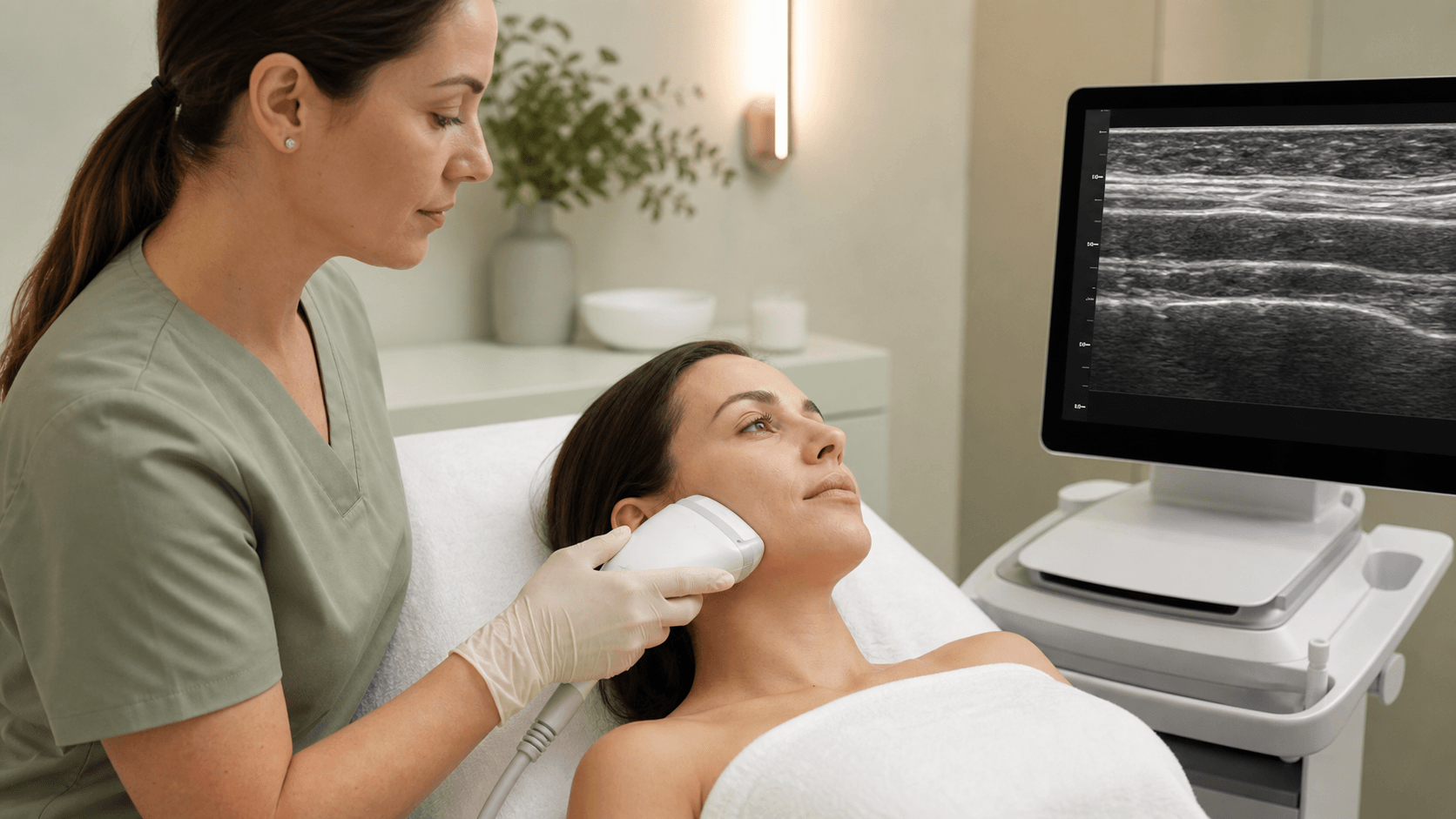
Ultherapy PRIME is the newer generation of the Ultherapy platform. One of its defining features is real-time ultrasound imaging, allowing the practitioner to visualise tissue layers while planning and delivering treatment. Official information from Ultherapy explains that the system uses microfocused ultrasound with visualisation to target specific tissue depths. The original Ultherapy system also has a substantial history in aesthetic medicine, with the US FDA listing cleared indications including lifting skin on the neck, under the chin and on the eyebrow, as well as improving lines and wrinkles of the décolleté.
Ultraformer III, meanwhile, is another focused-ultrasound platform used for non-invasive face and body treatments. Its different cartridges allow energy to be delivered at selected depths depending on the area and treatment objective. This flexibility is part of why Ultraformer has become widely used in clinics offering non-surgical tightening treatments.
The difference therefore isn't simply “old HIFU versus new HIFU”. A better way to think about it is that they are two platforms built around focused ultrasound, with different systems for helping practitioners deliver that energy.
The Most Important Ultherapy PRIME Feature Isn't More Power—It's Seeing Where You're Treating
Cosmetic-device marketing often revolves around numbers: more shots, more energy, faster treatment, deeper treatment. But when you are treating a face, precision can be more interesting than power.
Ultherapy PRIME's real-time imaging allows practitioners to see relevant tissue layers before and during energy delivery. This is important because faces are not built like identical diagrams. The thickness and position of different tissue layers vary between people and between different areas of the same face.
Research into microfocused ultrasound with visualisation (MFU-V) has examined its use for non-invasive lifting and tightening across the face and neck. A systematic review published in the *Journal of Cosmetic Dermatology* evaluated microfocused ultrasound for facial rejuvenation and found evidence of improvement in skin laxity, while also noting variation between studies and treatment protocols.
That doesn't mean imaging automatically makes Ultherapy PRIME “better” for every client. It means it provides a particular advantage: the practitioner isn't working from surface anatomy alone when determining where energy is being delivered.
For someone specifically researching Ultherapy PRIME Canberra, that distinction is more meaningful than asking how many lines another person received.
“I Want a Sharper Jawline” Is Still Not a Treatment Plan
Jawline concerns are probably one of the biggest reasons people start searching for ultrasound lifting treatments. Social media makes the request sound simple: soften the jowls, sharpen the jawline, tighten everything underneath.
Real facial anatomy is less cooperative.
A less-defined jawline can be influenced by skin laxity, underlying fat distribution, skeletal structure, age-related tissue changes or a combination of several factors. Focused ultrasound is primarily being considered in the context of tissue tightening and lifting, so it shouldn't automatically be expected to create the same result for every type of lower-face concern.
This is why before-and-after photographs can be useful but also misleading when taken as promises. Someone with mild skin laxity may respond differently from someone whose lower-face appearance is strongly influenced by facial volume or anatomy. The question isn't simply whether Ultherapy PRIME or Ultraformer III can treat the jawline. It is whether the concern creating *your* jawline appearance is something ultrasound tightening can realistically improve.
Sycamore's wider skin and facial treatment range is useful here because not every aesthetic concern needs to be forced into a lifting-treatment category.
Treatment Depth Is Where the Comparison Gets More Interesting
Focused ultrasound is appealing partly because it can deliver energy beneath the surface without creating an open wound in the skin. But “deep” doesn't automatically mean “better”. Different depths correspond with different tissue levels and treatment objectives.
Ultherapy has traditionally used transducers designed for treatment at approximately 1.5 mm, 3.0 mm and 4.5 mm, depending on the treatment area and objective. Published literature on microfocused ultrasound discusses these depths in relation to dermal and deeper tissue targeting. Ultraformer III also offers multiple cartridges designed to treat at different depths, giving practitioners flexibility across facial and body areas.
This is an important point because consumers sometimes compare ultrasound treatments by asking which device “goes deeper”. That's a bit like asking which kitchen knife is best because it is the longest. The useful depth is the one appropriate for the tissue you're trying to treat.
A personalised plan may therefore use different treatment depths across the same face. The cheek, jawline, submental area and neck aren't necessarily treated as though they are one continuous piece of tissue.
This is also why copying someone else's number of shots from Reddit or Instagram isn't particularly useful. Their anatomy, treatment area and clinical plan may have very little to do with yours.
What About Pain? This Is Where Online Reviews Become Interesting
Search “Ultherapy pain” and you will find wildly different experiences.
Some people describe the sensation as manageable warmth or brief pulses. Others describe certain areas—particularly around the jaw—as much more intense. Online communities such as Reddit's 30PlusSkinCare contain extensive discussions of Ultherapy, HIFU and ultrasound tightening experiences, ranging from very positive treatment stories to people who found the procedure uncomfortable.
These anecdotes are useful for understanding the *human experience* of treatment, but they aren't a reliable way to predict your own. Pain perception varies enormously, and treatment settings, device, area, protocol and individual sensitivity can all influence comfort.
Ultraformer III is also frequently discussed in terms of comfort and treatment flexibility, but again, “Ultraformer doesn't hurt” or “Ultherapy hurts” are too simplistic to be useful. If comfort is one of your biggest concerns, it deserves to be part of the consultation rather than something you try to resolve from a stranger's Reddit comment.
Can You See the Result Straight Away?
This is another place where expectations can get distorted.
Ultrasound lifting treatments are often chosen specifically because they are not surgical facelifts, but that also means it makes little sense to expect an immediate surgical-style transformation. Focused ultrasound creates controlled thermal coagulation points within targeted tissue, initiating a biological response that includes collagen remodelling over time.
A review of microfocused ultrasound in aesthetic medicine describes collagen contraction and subsequent remodelling as part of the mechanism behind gradual tightening after treatment.
So you may notice some early change, but the more meaningful result is generally discussed over the following weeks and months rather than the moment you leave the clinic. This applies to the broader category of focused-ultrasound treatments, including both Ultherapy and Ultraformer.
If someone is looking for a dramatic change by next Saturday, this treatment category may not match the timeline they have in mind.
What Happens After the Results Develop?
One question that gets much less attention than “How quickly will I see results?” is what happens after those results appear. Neither Ultherapy PRIME nor Ultraformer III should be thought of as a permanent pause button for facial ageing. Focused ultrasound can stimulate a tissue response and collagen remodelling, but your skin and underlying facial structures will continue to change naturally over time. Research into microfocused ultrasound for facial rejuvenation has generally assessed improvement over a period of months rather than suggesting that one treatment creates a permanent result. This is why maintenance is better discussed as an individual treatment-planning question rather than following a universal rule such as “everyone needs HIFU once a year.”
That also means you shouldn't automatically schedule your next treatment before seeing how your face responds to the first one. Someone with early laxity who is satisfied with a subtle improvement may have very different future needs from someone whose skin continues to change more noticeably. Lifestyle, ageing, sun exposure and individual collagen response can all influence how results evolve. Sycamore's broader skin rejuvenation treatment range is useful here because your next treatment doesn't necessarily need to be another ultrasound session either. Over time, your priority might shift from lifting to pigmentation, texture or general skin quality. A good long-term plan should therefore follow how your face changes, rather than turning one successful treatment into an automatic recurring appointment.
Ultherapy PRIME vs Ultraformer III: What About Different Ages?
There isn't a magical birthday when someone suddenly becomes an “Ultherapy person” or an “Ultraformer person”.
A client in their 30s noticing early changes around the jawline may have completely different goals from someone in their 50s with more established laxity. But chronological age alone still doesn't tell the whole story. Genetics, facial structure, skin quality, sun exposure, previous treatments and the degree of laxity all matter.
This is one reason responsible treatment planning should focus on what is actually present, rather than advertising ultrasound lifting as something everyone needs once they reach a particular age.
It also prevents another increasingly common problem: treating younger faces simply because preventive aesthetic procedures are trending online. If there isn't a meaningful concern for the treatment to address, “starting early” doesn't automatically make a procedure necessary.
Can Ultrasound Replace a Facelift?
This question deserves a short answer: not in the way social media sometimes suggests.
A surgical facelift can reposition tissues and address structural ageing in ways a non-invasive energy device cannot reproduce. Focused ultrasound occupies a different space: clients interested in improving mild-to-moderate laxity without surgery, incisions or the recovery associated with an operation.
Sycamore has already explored this distinction in HIFU vs Facelift Canberra, and the American Society of Plastic Surgeons provides further information about what a surgical facelift actually involves.

That difference shouldn't be treated as a weakness of Ultherapy PRIME or Ultraformer III. It simply means the treatment and the expectation need to live in the same category. Someone wanting subtle non-surgical tightening and someone wanting substantial surgical repositioning are asking for different things.
What If Ultrasound Isn't Actually the Treatment You Need?
This may be the most useful question in the entire comparison.
Sometimes someone searches for Ultherapy PRIME Canberra because their face “looks older”, but the thing bothering them isn't primarily laxity. It could be pigmentation, rough texture, dehydration or another change entirely. Ultrasound tightening isn't designed to perform the same job as every other skin technology.
If texture and skin quality are more important than lifting, Sycamore's previous Microneedling Canberra content explores a different treatment pathway. If your concern is simply tired, dehydrated-looking skin, the clinic's Korean Style Facial Treatment sits at an entirely different level of treatment intensity. And if pigmentation is what makes your complexion look older, Sycamore's advanced skin treatments provide other directions to investigate.
This is why consultation shouldn't begin with “I saw Ultherapy on Instagram, so I want Ultherapy.” It should begin with “This is the change I see in my face—what is actually causing it?”
Ultherapy PRIME vs Ultraformer III: Which One Fits Your Face?
There isn't a useful universal winner.
Ultherapy PRIME may be particularly attractive to clients and practitioners who value real-time ultrasound visualisation and a platform with an established evidence base in microfocused ultrasound lifting. Ultraformer III offers another focused-ultrasound pathway with multiple treatment depths and flexibility across different treatment areas.
But technology only becomes useful when it is paired with the right face, concern and treatment plan.
Instead of choosing based on which machine has the most impressive advertisement, ask better questions during your consultation. What exactly is creating the change you dislike? Which tissue is being targeted? Why has that treatment depth been selected? What degree of improvement is realistic? When should results develop? And importantly, would another treatment make more sense for your concern?
You can explore Sycamore Medi Spa's full range of treatments, continue reading the clinic's HIFU vs Facelift Canberra guide, or see current treatment and clinic content through Sycamore Medi Spa's Instagram.
Because when comparing Ultherapy PRIME vs Ultraformer III in Canberra, the smartest question isn't “Which machine is better?”
It's “Which approach makes sense for my face?”