IPL for Acne in Canberra: What to Know Before Summer
Acne rarely waits for a convenient time to appear.
You can have relatively calm skin for weeks and then notice several inflamed breakouts just as the weather gets warmer, your social calendar becomes busier and you start spending more time outdoors. For some people, the frustration is not only the pimples themselves. It is the cycle that follows: inflammation settles, a red or brown mark remains, another breakout appears nearby, and suddenly the skin never seems completely clear.
This is where people often start searching for acne treatment in Canberra and come across IPL.
IPL is better known to many people as a treatment associated with pigmentation, redness or general skin rejuvenation. However, Sycamore Medi Spa also offers a dedicated IPL for Acne treatment using the Venus Versa™ platform. Sycamore describes this treatment as using dual light technology to address existing acne-related inflammation while targeting acne-causing bacteria, with the aim of supporting clearer-looking skin and reducing future breakouts.
You can explore the service directly on Sycamore’s IPL for Acne treatment page.
But before booking IPL simply because you have “acne”, there is an important distinction to make:
Are you trying to treat active breakouts—or what previous breakouts have left behind?
Those are not necessarily the same treatment goal.
IPL for Acne Is Not the Same as IPL for Skin Rejuvenation
One reason IPL can be confusing is that the same broad technology family can appear under different treatment names.
Sycamore currently lists both IPL for Skin Rejuvenation and IPL for Acne within its Skin Rejuvenation category. The fact that both use IPL does not mean the appointments are interchangeable.
IPL stands for Intense Pulsed Light. Unlike a laser that emits a more specific wavelength, IPL uses broad-spectrum light, with treatment parameters selected according to the intended target. A review of IPL technology indexed by PubMed explains that combinations of wavelengths, fluence, pulse duration and pulse intervals allow IPL devices to be used across different dermatological and cosmetic applications. PubMed’s review of Intense Pulsed Light technology provides a useful overview of how the technology works.
This matters because “I had IPL before” does not tell the whole story.
An IPL treatment designed around visible pigmentation or photodamage should not automatically be assumed to be the same protocol as an acne-focused treatment.
At Sycamore, the dedicated acne treatment uses Venus Versa™. According to Sycamore’s IPL for Acne treatment page, the treatment is intended for concerns including mild to moderate acne, frequent breakouts and persistent inflammation that has not fully responded to topical skincare alone.
So when you book an IPL consultation, the word acne matters just as much as the word IPL.
Why Active Acne and Acne Scars Need to Be Separated
Imagine two clients both saying:
“I want acne treatment.”
The first currently has inflamed pimples appearing across the cheeks and chin.
The second rarely gets new pimples anymore but has uneven texture and indented scars from acne several years ago.
They are using the same word to describe two very different skin situations.
Sycamore positions IPL for Acne primarily around active acne, inflammation and redness, rather than treating every possible consequence of acne. For someone whose breakouts have already settled but whose main concern is residual texture or scarring, the treatment conversation may move elsewhere.
Sycamore explores that distinction in Can Microneedling Help with Acne Scars, Pores, and Fine Lines? A Canberra Guide, which focuses more specifically on the textural changes that can remain after acne.
This distinction is important for SEO searches too. Someone searching acne treatment Canberra may need help controlling active inflammatory acne. Someone searching acne scar treatment Canberra may no longer have significant active acne at all.
Treating those searches as identical can create unrealistic expectations.
What Is IPL Actually Trying to Do for Active Acne?
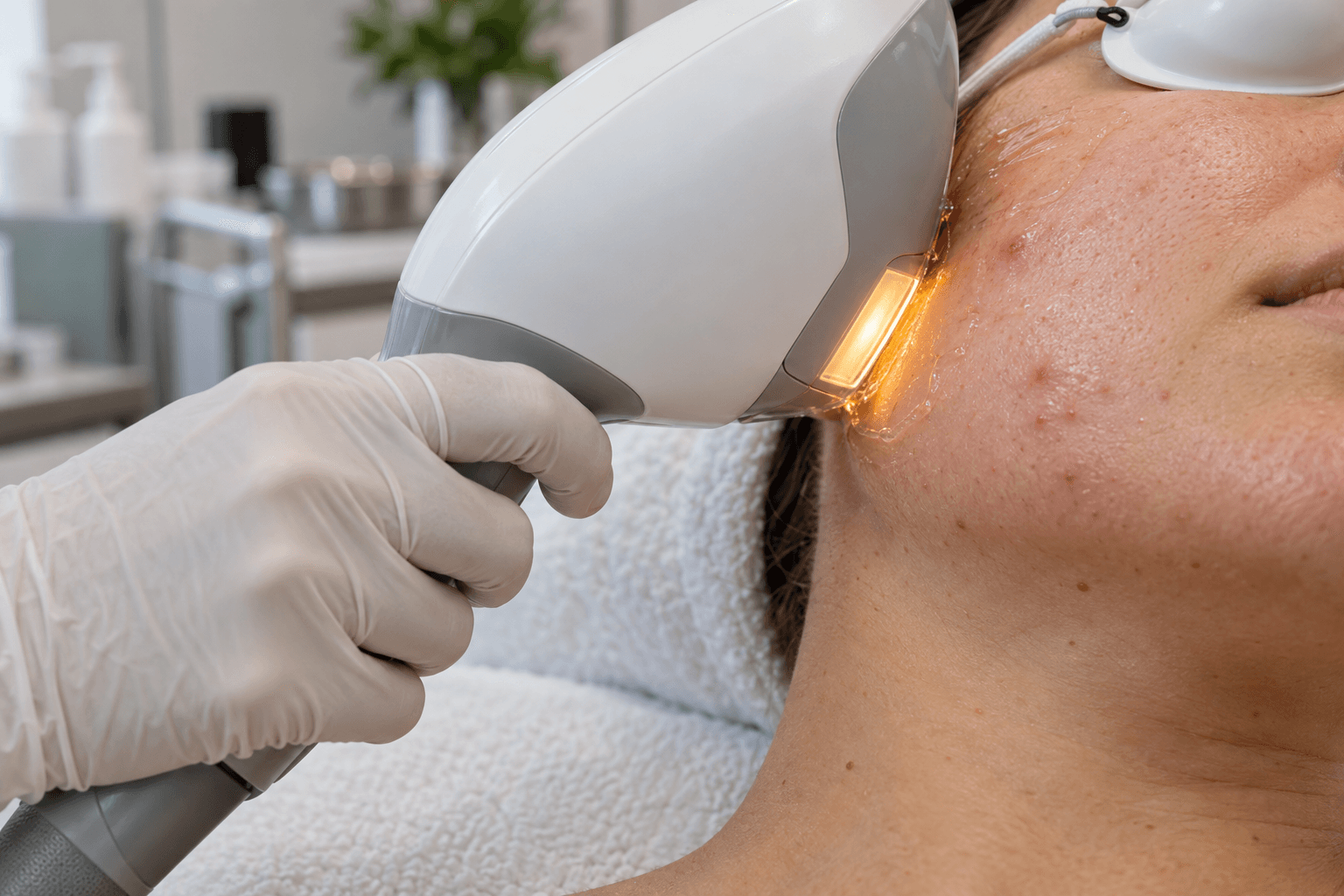
Sycamore describes its Venus Versa™ acne treatment as using dual lights that work on existing acne-related inflammation while also targeting acne-causing bacteria. The clinic lists potential benefits including reducing active acne, calming breakout-related redness and inflammation, and supporting clearer and smoother-looking skin.
You can read Sycamore’s complete description through its IPL for Acne treatment page.
There is also published research examining IPL for acne vulgaris.
A review of inflammatory skin conditions indexed by PubMed evaluated 42 studies involving several conditions, including acne vulgaris, and concluded that evidence supported IPL as an option that can improve acne, although outcomes depend on the condition and treatment approach. The review is available through PubMed’s Intense Pulsed Light Treatment for Inflammatory Skin Diseases.
However, the wider evidence deserves some nuance.
A separate meta-analysis involving eight randomised controlled trials and 450 participants found that IPL was not consistently superior to other supplementary acne therapies, particularly for inflammatory lesions, and highlighted heterogeneity between studies. You can review the IPL acne meta-analysis on PubMed.
That is an important reality check.
IPL should not be presented as a miracle cure for every form of acne. Evidence varies according to the treatment protocol, acne type and comparison treatment, and an individual result cannot be guaranteed from published studies.
The more useful way to think about IPL is as one possible component of acne management for an appropriately selected client.
Acne Treatment Should Not Begin With “How Strong Can We Go?”
Acne can make people impatient.
When you have spent months trying cleansers, spot treatments and new skincare products, it is understandable to want the strongest professional treatment available.
But stronger is not automatically smarter.
Inflamed skin is already dealing with an active process. Adding multiple aggressive treatments, exfoliating products and home remedies at the same time can make it difficult to tell what your skin is responding to.
This is one reason a professional assessment matters before IPL.
Sycamore’s broader treatment range includes a dedicated Acne Treatment category as well as IPL for Acne within Skin Rejuvenation. The presence of different acne-related services reflects an important point: not every person with breakouts should receive exactly the same treatment.
Your practitioner may need to consider how inflamed the acne is, whether there are open areas, what skincare you currently use, whether you are taking acne medication, your recent sun exposure and what your actual goal is.
In some cases, IPL may fit into the plan.
In others, another approach—or medical assessment—may need to come first.
Mild Breakouts and Severe Cystic Acne Are Not the Same Situation
The word “acne” covers a broad range of presentations.
A few inflamed pimples, persistent mild-to-moderate breakouts and severe painful cystic acne are not interchangeable conditions.
Sycamore describes its IPL for Acne service as suitable for people experiencing mild to moderate acne, frequent breakouts or persistent inflammation, while its pre-treatment guidance specifically states that areas with severe cystic flare-ups should not be treated unless advised by a practitioner.
That boundary is important.
Professional cosmetic treatment should not delay appropriate medical care when acne is severe, painful, rapidly worsening or causing significant scarring.
The American Academy of Dermatology provides extensive patient guidance explaining that acne treatment depends on acne type and severity and that treatment may include topical medicines, oral medicines and procedures depending on the individual situation. American Academy of Dermatology acne information is a useful resource if you want to understand acne from a dermatological perspective.
IPL belongs within that larger conversation. It does not make every other acne treatment unnecessary.
Why Your Acne Routine Matters Before IPL
If you already have acne, there is a good chance you are using active skincare.
That might include retinoids, benzoyl peroxide, salicylic acid, exfoliating products or prescription medication.
This information matters before a professional light-based treatment.
Sycamore’s IPL for Acne treatment guidance advises clients to discontinue acne-active products such as retinoids, benzoyl peroxide, salicylic acid and exfoliating treatments for approximately one to two weeks before the procedure. The clinic also asks clients to disclose oral and topical acne medications.
Do not simply stop prescription acne medication based on an article, however.
If a medication has been prescribed by a doctor or dermatologist, discuss treatment timing and medication changes with the relevant healthcare professional and your treating practitioner rather than making the decision yourself.
The consultation is also the time to mention other treatments you have recently received.
More treatment does not always equal faster improvement, particularly if several procedures or active ingredients are being layered together without enough recovery time.

Summer Acne Can Create a Skincare Trap
Warmer weather can change how your skin feels day to day.
You may sweat more. You may wear sunscreen more consistently. Outdoor exercise, hats, makeup, commuting and longer days outside can all change the environment around your skin.
When breakouts appear, a common reaction is to clean more aggressively.
You start washing your face more often, adding exfoliating acids, applying stronger spot treatments and trying to “dry everything out”.
That can turn acne management into a cycle of constant intervention.
The goal of an acne routine should not be to make your face feel as dry as possible.
Acne is not evidence that your skin is dirty, and aggressive scrubbing does not address all of the biological factors involved in acne. Sycamore discusses this more broadly in Acne Treatment Explained: Why Breakouts Happen and What Can Actually Help.
That article is a useful companion to this IPL guide because it looks at acne as the condition itself, while this article focuses specifically on where IPL for Acne may fit into professional treatment planning.
Why Sun Exposure Matters Before IPL for Acne
This becomes particularly relevant in Canberra as we move toward summer.
You may be seeking acne treatment because your skin is breaking out more, while at exactly the same time spending more weekends outside.
That combination matters for IPL.
Sycamore advises avoiding excessive sun exposure or tanning for at least four weeks before IPL for Acne. After treatment, its guidance recommends avoiding sun exposure and using daily sunscreen for at least four weeks.
This is not simply an optional aftercare detail.
Light-based treatment needs to be planned around the condition of the skin at the time of treatment. Recent tanning or significant UV exposure can change treatment considerations, while sunburned or compromised skin may mean an appointment needs to be postponed.
Cancer Council Australia’s sun-safety guidance recommends combining sun-protection measures such as protective clothing, sunscreen, shade, hats and sunglasses when UV protection is required.
For someone planning IPL in Canberra, that means your calendar matters.
If you have a beach holiday coming up, spend long periods outdoors for work, play outdoor sport or know you will have significant sun exposure, mention it before treatment.
The “best” appointment is not necessarily the earliest available appointment.
It is the appointment that fits safely into what your skin and your lifestyle are actually doing.
What Happens After IPL for Acne?
People often focus heavily on preparing for IPL but underestimate what happens afterwards.
According to Sycamore’s IPL for Acne treatment page, mild redness or warmth can occur and commonly resolves within approximately one to three days. Temporary mild swelling, dryness or a short-term acne flare may also occur.
Sycamore recommends gentle, non-comedogenic skincare after treatment, avoiding picking or squeezing the treated area and pausing exfoliating acids and acne actives for approximately seven to fourteen days. The clinic also recommends avoiding makeup for the first 24 hours where possible, particularly heavy or occlusive products.
This is a useful reminder that minimal downtime does not mean zero aftercare.
You may be able to continue normal daily activities relatively quickly, but your skincare routine may need temporary adjustment.
If your normal routine involves several acne actives, do not rush to restart everything because you see a new pimple two days later.
Follow the aftercare instructions provided for your treatment and ask when each product should be reintroduced.
What If Your Acne Improves but the Marks Stay?
This is one of the most frustrating stages of acne treatment.
You finally stop getting as many active breakouts, but when you look in the mirror, your complexion still does not appear “clear”.
That may be because the skin is carrying evidence of older inflammation.
Post-acne changes can include lingering red marks, brown pigmentation and textural scars. These are different concerns, and they may not all respond to the same approach used to manage active breakouts.
This is why treatment goals often need to change over time.
At first, the priority may be reducing active inflammatory acne.
Later, the priority may shift toward post-acne pigmentation.
After that, someone with established textural scarring may want to discuss a treatment such as microneedling.
Sycamore’s article Stop Covering Acne Scars — Start Rebuilding Your Skin with Microneedling in Canberra explores that later stage in more detail.
This does not mean every acne client needs to progress through a fixed sequence of IPL, pigmentation treatment and microneedling.
It means your treatment goal should be reassessed as your skin changes.
The procedure that made sense when you had ten inflamed lesions may not be the procedure you need when the breakouts are controlled and only texture remains.
Don’t Confuse a Post-Acne Mark With an Acne Scar
These terms are often used interchangeably online, but they can describe very different things.
A flat red or brown area remaining after a pimple is not necessarily the same thing as a depressed or raised textural scar.
That distinction affects treatment planning.
If the skin is flat but discoloured, the concern may be predominantly colour. If there is an indentation or textural change, the concern involves the skin’s structure. If there is still an active inflamed lesion, you are dealing with another stage again.
Sycamore discusses the relationship between acne, pigmentation and treatment sequencing in Canberra Skin Solutions: Laser, Microneedling & Ultherapy for Pigmentation, Acne and Firmness.
Understanding these distinctions can prevent a common mistake: choosing a treatment because you recognise the word “acne” in its name rather than because it matches what is currently visible on your skin.
Why Treating Acne Before It Scars Matters
For someone with active acne, it is easy to focus on the breakout that is visible today.
But repeated inflammation can have longer-term consequences.
Acne can leave pigmentation and permanent textural scarring, particularly when inflammatory lesions are severe or repeatedly manipulated. Picking and squeezing also increases trauma to already inflamed skin.
That is one reason acne management should not be reduced to covering spots until they disappear.
If breakouts are frequent, painful or beginning to leave scars, getting appropriate professional or medical advice earlier can be more useful than continually changing products without a plan.
The American Academy of Dermatology’s acne resources note that early and appropriate treatment can help reduce the risk of acne scars.
For cosmetic treatment planning, this also changes the objective.
The immediate goal is not necessarily flawless skin after one appointment. It may be to reduce the cycle of active inflammation first so that you are not continually creating new marks while trying to treat old ones.
That is a much more realistic way to think about progress.
Does IPL Replace Your Home Acne Routine?
No.
A professional treatment appointment may be one part of acne management, but what happens between appointments still matters.
Your skincare routine should support the treatment plan rather than compete with it.
That does not mean building an elaborate ten-step routine. In fact, constantly adding new acne products can make it harder to understand what is helping and what is irritating your skin.
A practical routine is usually easier to maintain consistently.
Cleansing, appropriate moisturisation and sun protection remain important, while acne-specific active ingredients should be used according to professional or medical advice and adjusted around IPL when required.
If you have been prescribed acne medication, continue working with the healthcare professional managing that medication. If you are using non-prescription actives, tell your Sycamore practitioner exactly what they are rather than simply saying you use “acne skincare”.
Names and ingredients matter.
Retinoids, benzoyl peroxide and exfoliating acids are not interchangeable, and Sycamore’s pre- and post-treatment guidance gives them specific consideration around IPL.
Should You Book IPL Right Before a Christmas Party?
Probably not as an experiment.
When people hear “minimal downtime”, it is tempting to schedule a first treatment immediately before a major event.
But minimal downtime does not guarantee that your skin will look exactly the way you want it to on a particular date.
Sycamore notes that temporary redness, warmth, swelling, dryness or a short-term flare can occur following IPL for Acne. Individual responses vary.
If you have an important event, holiday or professional photos coming up, tell the practitioner during consultation rather than keeping the deadline to yourself.
It is also worth thinking beyond the event itself.
If the Christmas party is followed immediately by a week at the coast, the bigger scheduling issue may be your upcoming UV exposure rather than whether redness disappears before Friday night.
Summer skin planning should consider the entire few weeks around the treatment, not just the day of the appointment.
IPL Is an Option, Not a Promise of Permanent Acne Clearance
One of the most important expectations to set is that acne can be influenced by multiple factors.
Hormonal changes, medications, skincare, stress and other biological or lifestyle factors can affect breakouts. A professional treatment can target particular parts of the acne process, but that does not mean the skin becomes permanently incapable of developing another pimple.
Published evidence also supports a measured interpretation.
The PubMed meta-analysis on IPL for acne found mixed comparative results and specifically concluded that its findings should be interpreted cautiously because of differences between studies and limited large-scale evidence.
That kind of evidence is useful because it prevents the conversation from becoming marketing.
IPL has been studied for acne and may have a role for suitable patients, but it should be selected because it makes sense for the individual—not because a device is presented as a universal solution.
For some clients, IPL may form part of a broader acne plan.
For others, skincare changes, medical treatment or another professional approach may be more appropriate.
What Should You Ask at an Acne Consultation?
You do not need to arrive knowing exactly which machine you want.
In fact, arriving with a diagnosis and treatment plan assembled entirely from social media can sometimes make the process more confusing.
Instead, bring useful information.
Explain how long you have been breaking out, where the acne usually appears, whether the lesions are painful, what happens after they heal, what products you currently use and whether you take any medication related to your skin.
Also mention upcoming travel and sun exposure.
If you have photographs showing how your acne looked during a more severe flare, those may help demonstrate patterns that are not obvious on a relatively calm consultation day.
Most importantly, be clear about what bothers you now.
Is it active pimples?
Redness?
Brown marks?
Scarring?
Oiliness?
A combination?
The answer may change which part of Sycamore’s treatment range is most relevant.
A Better Goal for Acne Treatment This Summer
The goal does not need to be “perfect skin before summer”.
That kind of deadline can encourage people to over-treat their skin, constantly switch products or expect one professional procedure to solve active acne, pigmentation and scarring simultaneously.
A more useful goal is more stable skin.
If you are experiencing active mild-to-moderate acne or recurring inflammatory breakouts, Sycamore’s IPL for Acne treatment may be one option worth discussing during consultation. The Venus Versa™ treatment is specifically included within Sycamore’s Skin Rejuvenation range for acne-related concerns.
If your acne is already controlled and your main concern is scarring or texture, the conversation may move toward treatments designed for that later stage instead. Sycamore’s microneedling guide for acne scars is a useful next read.
And if you want a broader understanding of why breakouts happen before deciding on a procedure, read Sycamore’s Acne Treatment Explained guide.
The important part is not choosing the most aggressive treatment or the newest device.
It is working out what stage your acne is currently in, what you are actually trying to improve, and whether IPL belongs in that plan.