Canberra Winter Wrecked Your Skin? Try a Korean Facial Reset Before Spring

Canberra winter has a way of showing up on your skin. By August, months of cold mornings, dry air and heated indoor spaces can leave your complexion feeling very different from the one you had at the beginning of the year. Your usual moisturiser may suddenly feel less effective, foundation can catch around the nose and cheeks, and skin that normally looks fresh can appear dull even after a good night's sleep. Research has found that seasonal changes can affect skin-barrier characteristics, including transepidermal water loss (TEWL) and epidermal ceramides, which helps explain why skin can behave differently during colder months. If your skin is showing these late-winter changes, Sycamore's Korean Style Facial Treatment offers a multi-step approach combining cleansing, exfoliation and nourishment rather than relying on one aggressive corrective step.
The natural reaction to winter-stressed skin is often to do more: add another serum, exfoliate more frequently, switch to a richer cream or order the latest “glass skin” product you saw online. But more skincare isn't necessarily better skincare. Sycamore's previous guide, Korean Facial Canberra: A Gentle Path to Hydrated, Balanced and Glowing Skin, approaches Korean-style skincare from a gentler perspective, while From Dull to Dewy: How a Korean Facial Helps Refresh Tired Skin focuses specifically on skin that feels flat, tight or less radiant. This article takes a different angle: with spring approaching, what does your skin actually need after several months of Canberra winter?

Your Winter Skin Problem Might Not Simply Be “Dry Skin”
“Dry” is usually the first word we use when winter skin starts misbehaving, but tightness, rough texture, flaking and dullness don't necessarily have one single cause. The outermost layer of the skin plays an important role in retaining water and protecting the tissue beneath it, and research has found seasonal differences in epidermal ceramides and TEWL during winter. Ceramides are an important component of the lipid structure of the stratum corneum, so changes in this outer barrier can influence how comfortable and hydrated the skin feels. If you're interested in the science rather than another beauty-industry explanation, the research can be explored through PubMed.
This is particularly relevant when your response to winter dryness is to keep adding stronger products. Perhaps your complexion looks dull, so you introduce an exfoliating acid. Then it feels tight, so you add another serum. When that doesn't seem enough, you add an oil and a sleeping mask. Before long, a simple routine has turned into six or seven products trying to solve several slightly different problems at once. Sycamore's Korean Style Facial Treatment takes a different approach: the treatment combines several complementary steps instead of expecting one ingredient or technique to do everything. Sycamore's earlier article The Korean Facial Approach to Glowing Skin develops the same idea around balance, hydration and gentle renewal rather than dramatic overnight correction.
This is one reason Korean-style skincare has become interesting beyond the famous “10-step routine”. The useful lesson isn't that everybody needs ten products; it's that different steps have different purposes. Cleansing, exfoliation, hydration and nourishment aren't interchangeable, and doing more of one doesn't necessarily compensate for neglecting another. The Korean Style Facial at Sycamore reflects this multi-step philosophy through cleansing, exfoliation and premium botanical ingredients intended to support a radiant, balanced complexion. Clients who want to understand how this differs from more conventional facial approaches can also explore Sycamore's wider Korean Facial contentrather than treating every Korean-inspired facial as exactly the same.
The Late-Winter Skin Check: What Has Actually Changed?
Rather than deciding your skin is simply “bad” after winter, compare it with how it behaved a few months ago. Maybe your moisturiser used to keep your cheeks comfortable all day but now your skin feels tight again by lunchtime. Perhaps makeup that looked smooth in autumn catches around the nose, chin or fine lines, or you've gradually increased exfoliation because nothing seems to restore the brightness you remember from warmer weather. These small changes can tell you much more than chasing a particular beauty trend, especially when environmental conditions and seasonal variation can influence the way the outer skin barrier behaves. Research examining seasonal variation in stratum-corneum lipids has documented differences across the year, providing another reason to think of skincare as something that may need to adapt rather than remain identical every season.
Makeup can actually be an unexpectedly useful clue. If foundation suddenly looks heavier or emphasises texture, the foundation itself may not be the problem. A rough or dehydrated surface naturally gives makeup a different canvas, while skin that looks tired isn't necessarily “ageing faster”; hydration and surface texture can influence how smooth and luminous the complexion appears. This is where Sycamore's From Dull to Dewy article is particularly relevant, because it focuses on tired-looking skin rather than positioning every change as an anti-ageing problem. For clients looking for a treatment rather than another home-care experiment, the Korean Style Facial Treatment provides the corresponding treatment pathway.
The difference with a late-winter reset is timing. You're not simply asking how to create glow for one afternoon; you're asking what condition you want your skin to be in when Canberra moves into spring. If the main concern is surface dryness, dullness and a lack of radiance, a Korean-inspired facial may be a logical option. If the concern is more specific, Sycamore's broader Treatments page allows clients to explore alternatives rather than assuming one facial is suitable for every concern. The Korean Style Facial page itself points clients towards Customized Facial Treatment, SkinCeuticals Facial Treatment, Luxury Facial Care Treatment and Doctor Babor Facial Treatment as related options.
Why We're Not Telling You to Exfoliate Everything Away
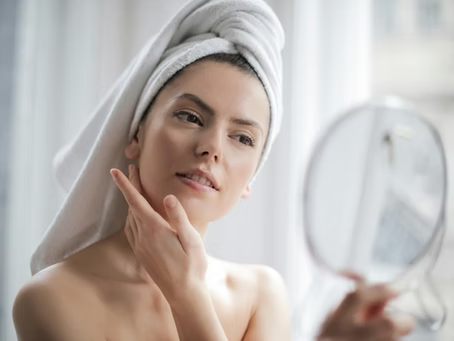
When skin looks dull, the temptation to exfoliate is strong. If there are dead cells on the surface, surely removing more of them will reveal brighter skin underneath. The problem is that “smooth” and “stripped” are not the same thing. Exfoliation can have a place in a skincare routine, but repeatedly reaching for stronger acids or more frequent scrubs because the skin doesn't look luminous enough may not be the most sensible response when it already feels tight or uncomfortable. This is where the treatment design matters: Sycamore describes its Korean Style Facial as combining exfoliation with cleansing and nourishment, rather than making exfoliation the entire point of the appointment.
That philosophy also appears in Sycamore's The Korean Facial Approach to Glowing Skin , which frames Korean-style facial care around balance, hydration, gentle renewal and consistency. This distinction is useful for winter skin because the aim isn't necessarily to remove as much as possible from the surface; it can be to combine appropriate surface renewal with steps that leave the complexion feeling nourished and refreshed. If your skin requires a more individual approach, Sycamore's wider facial and skin treatment range gives the practitioner other options rather than forcing the Korean Facial into every treatment plan.
The Skin Barrier Is More Than a TikTok Buzzword
If you spend any time watching skincare content, you've probably heard the phrase “damaged skin barrier” used to explain almost everything. The reality is more nuanced. The stratum corneum contains an organised mixture of lipids—including ceramides, cholesterol and fatty acids—that contributes to the skin's barrier properties, and research has examined how these components vary with season and skin condition. One study available through PubMed found seasonal differences involving epidermal ceramides and TEWL, while earlier research examining seasonal variation in stratum-corneum ceramides also identified changes across different times of year
That doesn't mean you should diagnose yourself with a “damaged barrier” because your cheeks feel dry in August, and it certainly doesn't mean a Korean Facial medically treats every barrier disorder. The more useful takeaway is that supporting the skin can sometimes make more sense than continually challenging it. Sycamore's existing Korean Facial content reflects this softer philosophy: From Dull to Dewy discusses cleansing, softening, hydration and nourishment, while The Korean Facial Approach to Glowing Skin focuses on balance and consistency. Together, these pages form a useful internal topic cluster around Korean facial care without forcing exactly the same explanation into every article.
“Glass Skin” Is a Goal, Not a Literal Skin Type
We can't write about Korean skincare without mentioning glass skin. The phrase has become almost inseparable from K-beauty, and Sycamore itself describes its Korean Style Facial as aiming for the coveted “glass skin” effect through a combination of cleansing, exfoliation and nourishment. But social media has sometimes turned glass skin into an unrealistic image of completely poreless, texture-free skin. Real skin has pores, texture and natural variation, so a more useful interpretation is a complexion that appears smooth, hydrated, balanced and naturally luminous. Sycamore's original Elevate Your Glow with Korean-Style Facial Treatments in Canberra explores this glass-skin philosophy in greater detail, so this seasonal article doesn't need to repeat the same treatment introduction.
Seen this way, the Korean Style Facial makes particular sense as a seasonal treatment. After months of Canberra winter, the goal doesn't have to be transforming your face or “correcting” every aesthetic concern; it may simply be restoring softness, hydration and radiance to skin that has become dull or uncomfortable. Clients interested in the treatment itself can go directly to the Korean Style Facial Treatment page , while those interested in the broader philosophy can continue through Sycamore's Korean Facial articles and skincare insights . This keeps each page useful for a different search intent rather than repeating the same “What is a Korean Facial?” explanation across the website.
Think of It as a Seasonal Wardrobe Change for Your Skin
You probably don't dress exactly the same way in Canberra in January and July, so it shouldn't be surprising if your skin doesn't want exactly the same routine either. Products that felt perfectly adequate during warmer weather may feel too light in winter, while the rich creams you reached for in July may begin to feel heavier as spring arrives. At the same time, your complexion may still be carrying some of winter's roughness, dehydration or dullness. Scientific research into seasonal skin-barrier changes supports the broader idea that skin characteristics can vary across seasons, so adjusting your routine isn't simply another skincare marketing trend.
This transition period can therefore be a useful time for a professional reset. A Korean Style Facial Treatment can focus on cleansing, exfoliation and nourishment, while Sycamore's broader professional treatment collection provides alternatives if your priorities turn out to be different. If you want to see how Sycamore combines surface-focused Korean facial care with more advanced aesthetic approaches, the clinic has also previously written about pairing the Sycamore Korean Facial with Ultherapy PRIME , clearly separating surface hydration and glow from deeper structural rejuvenation.
The key is that seasonal skincare should be responsive, not reactive. You don't need to replace your entire bathroom cabinet every three months, nor do you need to book every trending treatment. Notice what's actually changed, use evidence rather than social-media hype to understand why skin can behave differently across seasons, and then choose professional care that matches the concern. For a Canberra client whose late-winter priorities are hydration, gentle renewal and a fresher-looking complexion, the Korean Style Facial offers one logical pathway; for someone with a different concern, Sycamore's full treatment menu provides somewhere more appropriate to start.
Don’t Confuse Winter Dehydration With Suddenly “Getting Old”
Winter can play a visual trick on us. When skin becomes dehydrated and the surface feels rougher, fine lines may appear more noticeable, makeup can settle differently and the complexion can lose some of the plump, luminous quality people associate with healthy-looking skin. That can make it tempting to jump immediately from “my skin looks tired” to “I need an anti-ageing treatment”. Before doing that, it is worth separating surface skin quality from structural ageing. Research into moisturisation and the epidermal barrier shows that water content, barrier lipids and transepidermal water loss all influence how the outer skin looks and functions, so not every temporary change in appearance is evidence of sudden structural ageing. A useful scientific starting point is this research on seasonal changes in epidermal ceramides and TEWL , alongside earlier work examining seasonal variation in stratum-corneum ceramides.
This distinction also helps explain why Sycamore offers different treatments for different jobs. The Korean Style Facial Treatment focuses on cleansing, exfoliation, nourishment and a balanced, radiant complexion, while Sycamore's Customized Facial Treatment can be adapted around individual concerns such as texture, pore congestion and hydration. Sycamore has even explored how surface-focused facial care can sit alongside deeper rejuvenation technologies in A New Era of Skin Confidence: Discover Ultherapy PRIME and Sycamore Korean Facial in Canberra. The point isn't that you should combine treatments; it's that hydration, texture, pigmentation and structural laxity are different concerns and shouldn't automatically be treated in the same way.
What Real People Say About Winter Skin Is Surprisingly Familiar
Clinical research tells us what happens biologically, but everyday skincare conversations show how people actually experience it. Discussions in the SkincareAddiction community on Reddit frequently describe a familiar winter pattern: routines that worked perfectly well in warmer weather suddenly stop feeling sufficient when temperatures drop. One user described reaching the end of winter with skin that still felt dry all day despite using multiple hydrating products, while another discussion centred on cold wind, sensitivity and the challenge of protecting already-stressed skin. These aren't medical studies and shouldn't be treated as clinical evidence, but they are useful reminders that seasonal skincare frustration is hardly unusual.
The interesting lesson from these conversations isn't “buy the product Reddit recommends”. In fact, that's exactly what we're trying to avoid. Another highly discussed winter routine in the same community involved layering several hydrating and barrier-focused products because the user's combination skin became considerably drier during colder weather. Real-world experiences like these support a practical idea: winter skincare often becomes complicated because people keep adding products instead of reassessing the routine as a whole. This is where a professional facial can offer something your bathroom shelf cannot—a chance to stop experimenting and have the current condition of your skin considered before deciding what comes next.
From August to Spring: Your Sunscreen Still Matters
A post-winter reset isn't only about repairing the effects of cold weather. As Canberra moves towards spring, UV exposure becomes an increasingly obvious part of everyday life again, although sun protection should never be treated as a summer-only habit. This is particularly important if your goal is maintaining an even, healthy-looking complexion, because UV exposure is one of the major environmental factors associated with premature skin ageing and pigmentation. If you're investing time and money in facials designed to improve radiance and skin quality, daily photoprotection remains one of the simplest ways to protect that investment.
This also helps put the Korean “glow” philosophy into perspective. A facial may temporarily make the complexion appear smoother and more luminous, but long-term skin quality depends heavily on what happens outside the treatment room. Sycamore's The Korean Facial Approach to Glowing Skin emphasises balance, hydration and consistency rather than treating glow as something created in a single appointment. For clients who are new to the concept, Korean Facial vs Traditional Facial Canberra provides another useful route into the topic without repeating the seasonal focus of this article.
What Should Your Routine Look Like After the Facial?
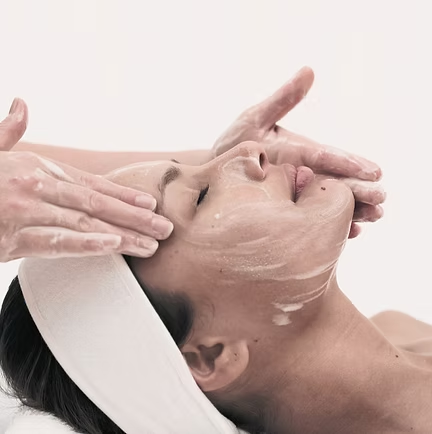
A good facial shouldn't send you home believing you need to replace everything in your bathroom. In fact, one of the best things you can do after a post-winter reset is resist the temptation to immediately introduce five new products. A manageable routine built around appropriate cleansing, moisturising and sun protection is often a better foundation than continually rotating trending actives. If you're already using retinoids, exfoliating acids or other active products, the question should be whether they still suit your skin's current condition and how they fit around professional treatment—not how many more actives you can add.
The same logic applies to professional treatments. If the Korean Style Facial suits your current goal, that doesn't mean it must become the only facial you ever have. Your needs can change with the season, lifestyle and skin condition. Sycamore's Customized Facial , for example, includes individualised masks and options such as ultrasonic infusion and LED light therapy, while its Luxury Facial Care Treatment uses Fillmed Skin Perfusion products and is positioned around concerns including dehydration, radiance, wrinkles, firmness and blemishes. Having different options is useful precisely because skin isn't static.
When a Korean Facial May Not Be What Your Skin Needs
A useful clinic blog shouldn't turn every skin concern into an excuse to book the treatment being discussed. If your primary concern is significant pigmentation, acne scarring, pronounced skin laxity or another specific condition, a hydration-and-radiance-focused facial may not be the most appropriate starting point. The Korean Style Facial Treatment is described by Sycamore around cleansing, exfoliation, nourishment and the “glass skin” aesthetic; it isn't presented as a universal replacement for the clinic's other skin technologies.
This is where Sycamore's internal content can actually help clients navigate instead of simply selling. Someone interested primarily in dull, tired-looking skin can continue to From Dull to Dewy: How a Korean Facial Helps Refresh Tired Skin, while somebody still deciding what style of facial suits them can read Korean Facial vs Traditional Facial Canberra. Clients with a different concern can instead browse Sycamore's complete Treatments collection rather than trying to make a Korean Facial solve a problem it wasn't designed to address.
Why a Post-Winter “Reset” Makes More Sense Than a Rescue Mission
The word “reset” is deliberate. Your skin doesn't need to be rescued simply because Canberra winter made it feel drier or look less radiant. A reset is about reassessing what you're doing, removing unnecessary complexity and choosing treatment based on the condition of your skin now rather than automatically repeating what worked six months ago. The research into seasonal barrier changes gives us a scientific reason to take these shifts seriously, while real-world skincare communities show just how common it is for routines to behave differently when the weather changes.
For clients whose priorities are hydration, gentle exfoliation, nourishment and a fresh, luminous finish, the Korean Style Facial Treatment at Sycamore Medi Spa offers a logical seasonal option. Sycamore's own description emphasises a multi-step treatment with premium botanical ingredients and a Korean-inspired “glass skin” finish, while its broader facial range allows another option to be chosen when the skin needs something different. You can also explore Sycamore's skincare and treatment articles or follow Sycamore Medi Spa on Instagram to see more of the clinic's treatment content.
After months of Canberra winter, the answer isn't necessarily another aggressive treatment or another shelf full of skincare. Sometimes the smarter move is to understand what changed, simplify what isn't helping and give your skin the kind of treatment it actually needs before spring arrives.